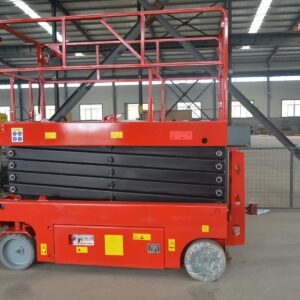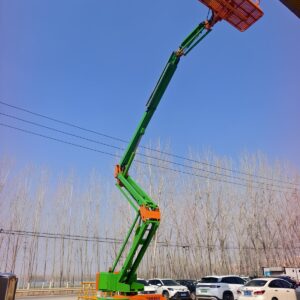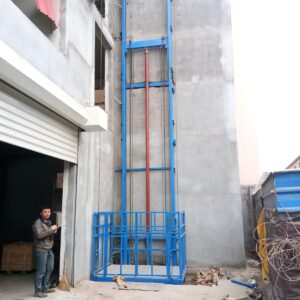
A mobile scissor lift is moved into place by hand and connected to a mains power supply. Outdoors, wind, an uneven yard, rain and a long cable route can change how that routine works. The machine’s platform height alone no longer answers the question; the ground, travel method and setup position become part of the choice.
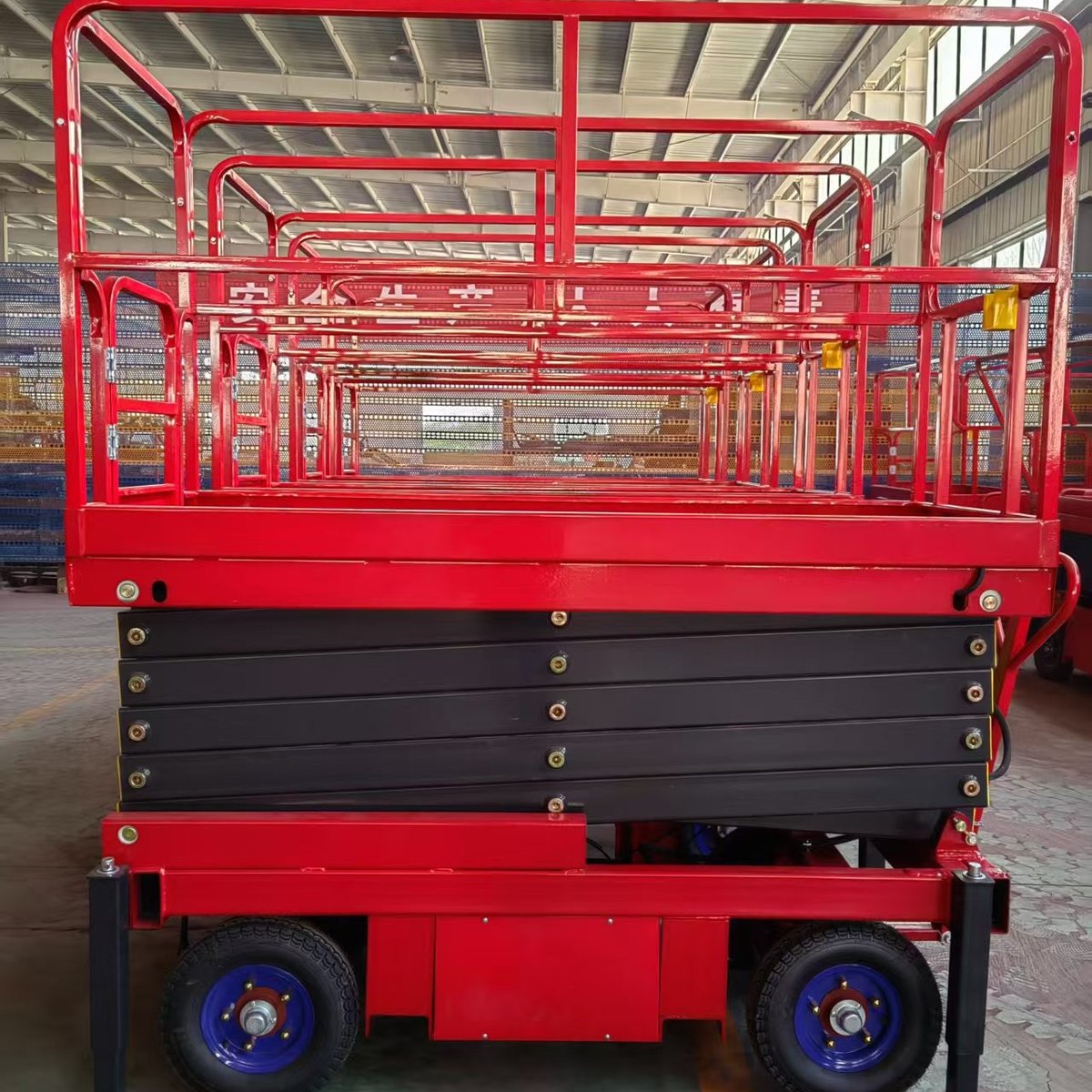
Can a standard mobile scissor lift be used outside?
Our mobile scissor lift range describes indoor work on firm, level ground and recommends a self-propelled scissor lift with rough-terrain tyres for outdoor work on uneven ground. The range itself covers 4 m to 18 m lift heights, uses AC 220 V single phase up to 11 m and AC 380 V three phase on the 12 m to 18 m models, and relies on pull-out outriggers for stability.
That distinction matters. The 18 m model is 3,950 kg and the 16 m model is 2,700 kg; these are hand-moved machines, not all-terrain vehicles. The four wheels and tow bar help position the lift on a suitable surface, but they do not turn a soft verge or a sloping yard into a level work pad.
What changes on an outdoor surface?
First, the ground has to suit the outriggers. Each outrigger applies load to a small footprint, so a hard timber pad can spread that load, but the pad must not rock or sink. Look for drains, covers, fresh trenches, patch repairs and soft asphalt. The platform should be positioned on ground that does not move while the lift is raised.
Second, access becomes more involved. Cable, hose and vehicle routes have to remain clear around the outrigger frame. A 220 V cable must not be stretched across a traffic route, and the power source must be suitable for outdoor use and protected from water. These checks are separate from the lift’s internal control voltage; the machine uses 24 V safe control voltage, but the supply cable and connection still need proper site protection.
Mobile lift or self-propelled lift?
A mobile unit is moved manually and operates from mains power. A self-propelled unit uses an onboard battery and drives from the platform controls. The right outdoor setup is not determined by the word “mobile”; it depends on the surface, access and power available.
| Outdoor consideration | Mobile scissor lift | Self-propelled scissor lift |
|---|---|---|
| Movement | Hand pushed with the tow bar | Driven from the platform controls |
| Power | AC 220 V single phase on 4 – 11 m; AC 380 V three phase on 12 – 18 m | Onboard battery; 24 V electric drive listed on the GTJZ range |
| Setup | Pull-out outriggers on firm, level ground | Drive the chassis into position, then follow the model setup requirements |
| Tyre example | 400-8 to 500-8 on the mobile scissor range | Non-marking solid tyres on the GTJZ range, with rough-terrain tyres listed as an option |
| Machine weight example | 1,280 kg at 10 m; 3,950 kg at 18 m | 2,450 kg on the GTJZ10 |
| Main outdoor check | Ground bearing under every outrigger and protected mains cable | Ground condition, route, turning area and battery work window |
Which model would an outdoor task need?
Start with the working height, not the stowed length. The mobile range runs from 4 m to 18 m lift height, with weights increasing from 670 kg on the 4 m model to 3,950 kg on the 18 m model. Longer legs and heavier structures make the bigger machine harder to move safely across an unprepared yard.
If the job is on a paved slab and a suitable mains supply is available, a smaller mobile lift may be practical. If the machine has to drive across a yard, enter over a rough transition or move repeatedly between positions, compare the self-propelled range. The GTJZ10, for example, has a 10 m platform height, 12 m working height, 320 kg load, 2,450 kg weight and 24 V / 3.3 kW electric drive.
What should be checked before the platform rises?
- Ground condition at every outrigger and wheel, including hidden voids or soft patches.
- Level of the setup position, using the machine’s own indicators and the operating manual.
- Weather exposure and route conditions during the work period.
- Overhead cables, branches and structures within the platform’s travel envelope.
- Power cable routing, protection, connectors and isolation from water and traffic.
- Access for people and tools without stepping over the outriggers.
Are there outdoor differences in the mechanism?
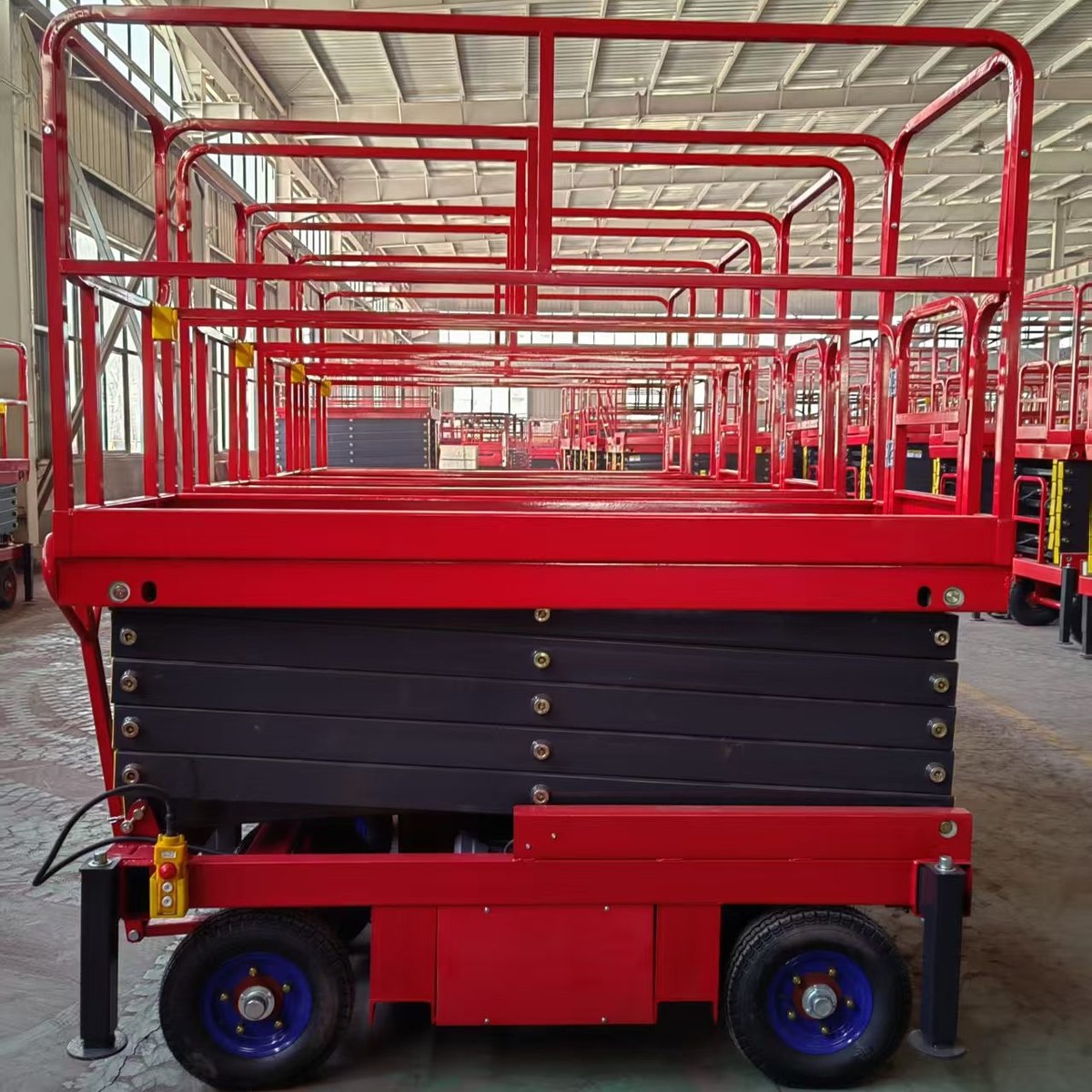
The mobile range uses a hydraulic cylinder, relief valve, emergency descent valve, limit switch and emergency stop. The platform guardrail is 1.1 m high in 30 x 30 mm square tube, and the finish is shot blasted before electrostatic powder coating. These features protect the normal operating functions; they do not replace a site-specific assessment of wind, ground or weather.
The catalogue’s separate full-electric mobile lift table is a material platform, not a personnel lift. Its battery travel can move equipment over suitable ground, but it must not be treated as an outdoor working platform for people.
Frequently asked questions
Can I put a mobile scissor lift on grass?
Do not assume so. The standard range is described for firm, level indoor floors, and its outriggers need stable bearing under each point. Grass, soil and gravel can settle or become uneven, so choose a prepared surface or a machine and setup method approved for that ground.
Can the 220 V model be plugged into an outdoor socket?
The 4 m to 11 m models use AC 220 V single-phase power and the 12 m to 18 m models use AC 380 V three-phase. The socket, cable, protection and weather exposure must be arranged for the actual site by a competent person; the lift being mains powered does not make every extension lead suitable.
Is a self-propelled scissor lift automatically safe outdoors?
No. A self-propelled machine changes how the lift travels and its tyre and drive options can better suit yard work, but ground condition, slope, overhead obstructions and weather still need checking. Select the machine and operating plan for the specific outdoor location.
Next step
Send photographs of the outdoor surface, the route, the power point and the work position. Start from the mobile scissor lift range or the self-propelled electric scissor lift range, and review how mobile and self-propelled scissor lifts differ.