Two scissor lifts can reach the same ceiling from the same floor and still be completely different machines to own. One is pushed into position by hand and plugged into a socket; the other drives itself on a battery. The choice is usually presented as a price question, but it is really a productivity question: how far the machine has to travel, how many stops it makes in a day, and whether there is a socket where it parks.
What the difference actually is
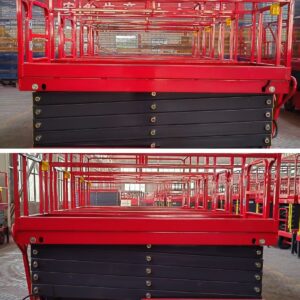
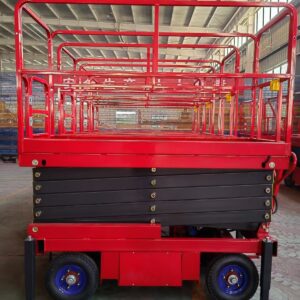
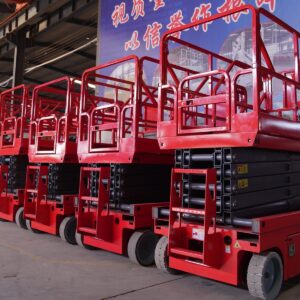
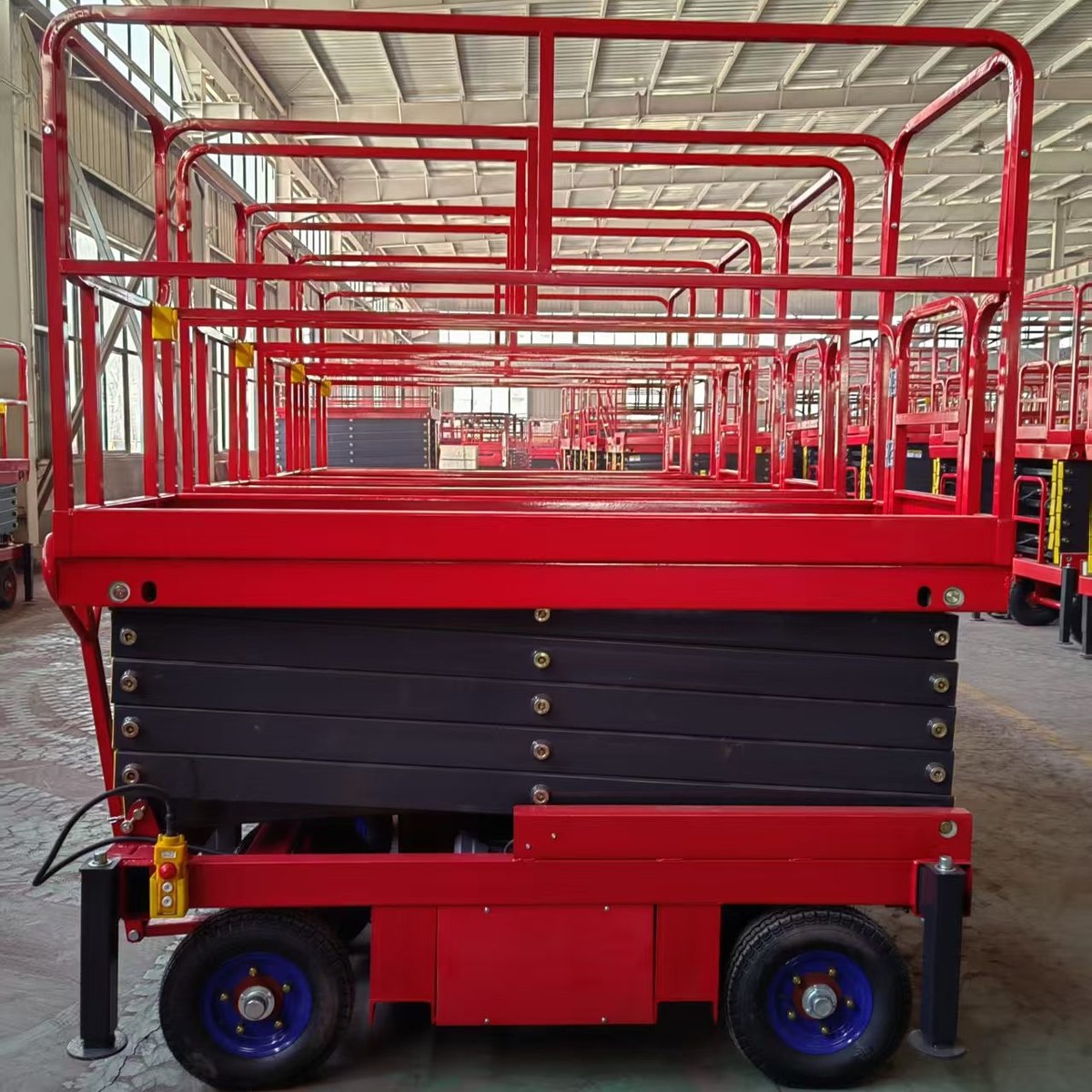
A mobile scissor lift runs on mains power, 220 V up to 10 m and 380 V above that, with a power unit of 1.5 kW to 2.2 kW. It is pushed by hand, its four outriggers are extended, and it lifts. A self-propelled scissor lift carries its own 24 V battery and drive motor, travels at up to 3.8 km/h stowed, climbs a 25% grade and is driven from the platform. Both lift a person to a ceiling; only one of them moves itself between ceilings.
| Mobile scissor lift | Self-propelled scissor lift | |
|---|---|---|
| Power | Mains, AC 220 V to 10 m; AC 380 V above | 24 V battery, 24 V / 30 A charger (15 A on the smallest) |
| Drive | Pushed by hand | Self-propelled, 3.8 km/h stowed, 0.8 km/h raised |
| Height range | 4 m to 18 m | 4.6 m to 13.8 m platform (6.6 m to 15.8 m working) |
| Capacity | 500 kg to 14 m, 300 kg at 16 m and 18 m | 450 kg at 6 m and 8 m, 320 kg at 10 m and 12 m, 230 kg at 13.8 m |
| Weight, 10 m machine | 1,280 kg | 2,450 kg |
| Gradeability | Level floor only | 25% |
| Best for | One workshop, fixed work, a socket at the machine | Large buildings, many stops, finished floors |
When the mobile lift wins
If the work is in one workshop, under one ceiling, and the machine will stay there for the job, a mobile lift is the economical answer. It has no battery to replace, no drive motor and no charger, and it is significantly lighter: our 10 m mobile model weighs 1,280 kg against 2,450 kg for the 10 m self-propelled machine. That weight matters when the lift has to go into a goods lift or onto an upper floor.
It also wins where the supply is already there. A 220 V socket beside the work is all the 10 m, 500 kg model needs, and the machine can be pushed into a corner and forgotten between jobs.
When the self-propelled lift wins
If the machine has to work across a building – several bays, a long warehouse, a series of rooms – pushing 1.2 to 2.5 tonnes by hand between stops is the slowest part of the day. A self-propelled machine drives at 3.8 km/h stowed and 0.8 km/h with the platform raised, which turns a ten-minute move into a one-minute one, and it does it without a cable trailing across the floor.
It also wins on floor loading and finish. The non-marking solid tyres and the lower ground pressure of a purpose-built chassis suit finished floors, and the machine can be driven straight into a goods lift or a truck without a team pushing it.
The productivity maths
Count the moves, not the lifts. A machine that makes twenty short moves a day across a warehouse gains more from driving itself than one that is set up once in the morning and left in place. Multiply the distance between stops by the number of stops, compare that with the 3.8 km/h a self-propelled machine travels, and the answer is usually obvious: above a few hundred metres of daily travel, the self-propelled machine pays back its extra cost quickly; below that, the mobile machine does the same work for less.
What to check before deciding
- Where the work is. One place, or a route across the building.
- What the supply is. 220 V single phase reaches 10 m; above that the mobile machines need 380 V three phase.
- How the machine moves between jobs. Goods lift, ramp, truck, or none of the above.
- Floor loading. The mobile 10 m machine weighs 1,280 kg; the self-propelled 10 m machine weighs 2,450 kg.
- Charging. A self-propelled machine needs a parking place with power, and a charger that suits the shift pattern.
Frequently asked questions
Can a mobile scissor lift be used across a large site?
It can, but it is not what it is built for. It has to be pushed by hand, it needs a supply at each stop, and a cable has to follow it. For a site with many stops and long distances, the self-propelled machine is faster and safer.
Do self-propelled lifts need charging infrastructure?
Yes. They use a 24 V charger, 30 A on the larger models and 15 A on the smallest, and they need a parking position with power where the machine can be left to complete a full cycle. Plan that at the quotation stage: the charging point, the parking bay and the cable length all have to suit the way the machine is used.
Which one is cheaper to own?
The mobile machine, because it has no battery to replace and fewer parts to wear. The self-propelled machine costs more up front and carries a battery as a long-term wear item, but it usually wins on labour: one operator instead of one operator plus a pusher, and minutes instead of tens of minutes between stops.
Next step
Tell us how far the machine travels in a day, how many stops it makes, what supply is available and how it moves between floors. We will tell you which machine pays off rather than which one is cheaper on paper. Start from the mobile scissor lift range or the self-propelled electric scissor lifts, and read how the supply decides the mobile model.