Cargo lift and freight elevator are used interchangeably in conversation and mean different things in a building. One is a goods-only platform that runs on guide rails fixed to the wall, the other is an enclosed lift that travels inside a shaft and can carry people. Choosing the wrong one is expensive in both directions: a shaft where a rail lift would have done, or a goods lift pressed into carrying passengers. This guide sets out the difference and how to decide.
What each machine actually is
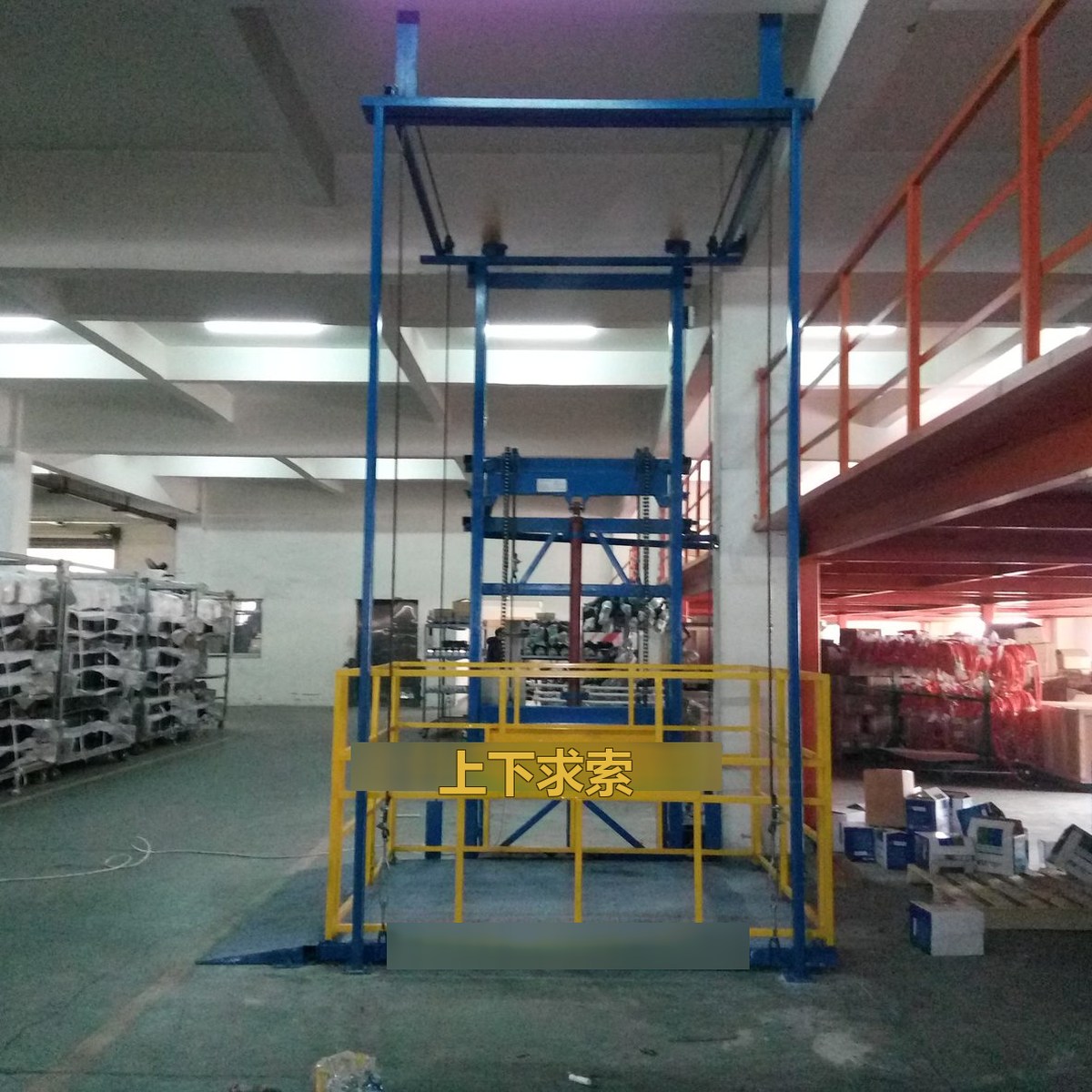
A cargo lift, in our range, is a platform that runs on two guide rails anchored to the wall or carried by a free-standing frame, driven by two 90 x 60 hydraulic cylinders through an LH1244 leaf chain. The standard model is the CL5-2.5: 2.5 t, 5 m of travel, a 1600 x 2200 mm platform, a 2200 x 2250 x 300 mm pit, a 7.5 kW pump station and 180 degree through loading. It is built for pallets, trolleys, drums and machine parts, and never for people.
A freight elevator is an enclosed lift inside a shaft, with a car, landing doors on every floor and a machine room or a machine-room-less drive. It carries goods and, in its passenger-rated form, people. Our rail lift and a freight elevator do the same job on paper, and almost nothing else in common on site.
The difference, side by side
| Guide rail cargo lift | Freight elevator | |
|---|---|---|
| Shaft | Not required: rails fix to the wall or a free-standing frame | Required |
| Pit | 300 mm shallow pit, or a pitless version with a ramp | Deep pit and machine room |
| People | Goods only, never for carrying people | Passenger-rated versions carry people |
| Installation | Your own team, from our drawing and manual | Specialist lift installer |
| Typical lead time | About 25 working days plus shipping | Longer, and the building work comes first |
| Space | Only the platform footprint plus the rails | Shaft, landing doors and machine room |
| Cost | A fraction of a shaft installation | Highest of the options |
When a cargo lift is the right answer
If the building exists and the goods move between two or three levels, a cargo lift is usually the practical choice. There is no shaft to build, the floor opening is only as big as the platform, the pit is 300 mm instead of metres deep, and the customer’s own fitters can install the machine from our assembly drawing. For a warehouse, workshop, food plant or mezzanine that was never designed with a lift shaft, that difference is the whole project.
When a freight elevator is the right answer
A freight elevator is the correct machine when people have to travel with the goods, when the building is new and a shaft can be designed in from the start, when the goods include pallets at a rate that justifies a car with doors, or when local rules require an enclosed lift for the height and the use. If any of those applies, a rail lift is the wrong machine however attractive the price looks.
What to prepare before you decide
- The goods, at their heaviest. 2.5 t on our standard model, with the pallet truck included.
- The floors and the travel. Base plus number of stops; 5 m on the standard model, other heights built to order.
- The platform. 1600 x 2200 mm as standard, or 2000 x 2500 mm, and the direction the trolley enters and leaves – 180 degree through loading on the standard build.
- The building. A sound wall or a free-standing frame for the rail anchors, a floor opening for the platform and its 1000 mm guardrail, and a landing gate on each level.
- The supply. 380 to 400 V, 50 Hz, three phase at the pump station, with 24 V control voltage and floor by floor calling from a PLC.
Two projects that chose the rail lift
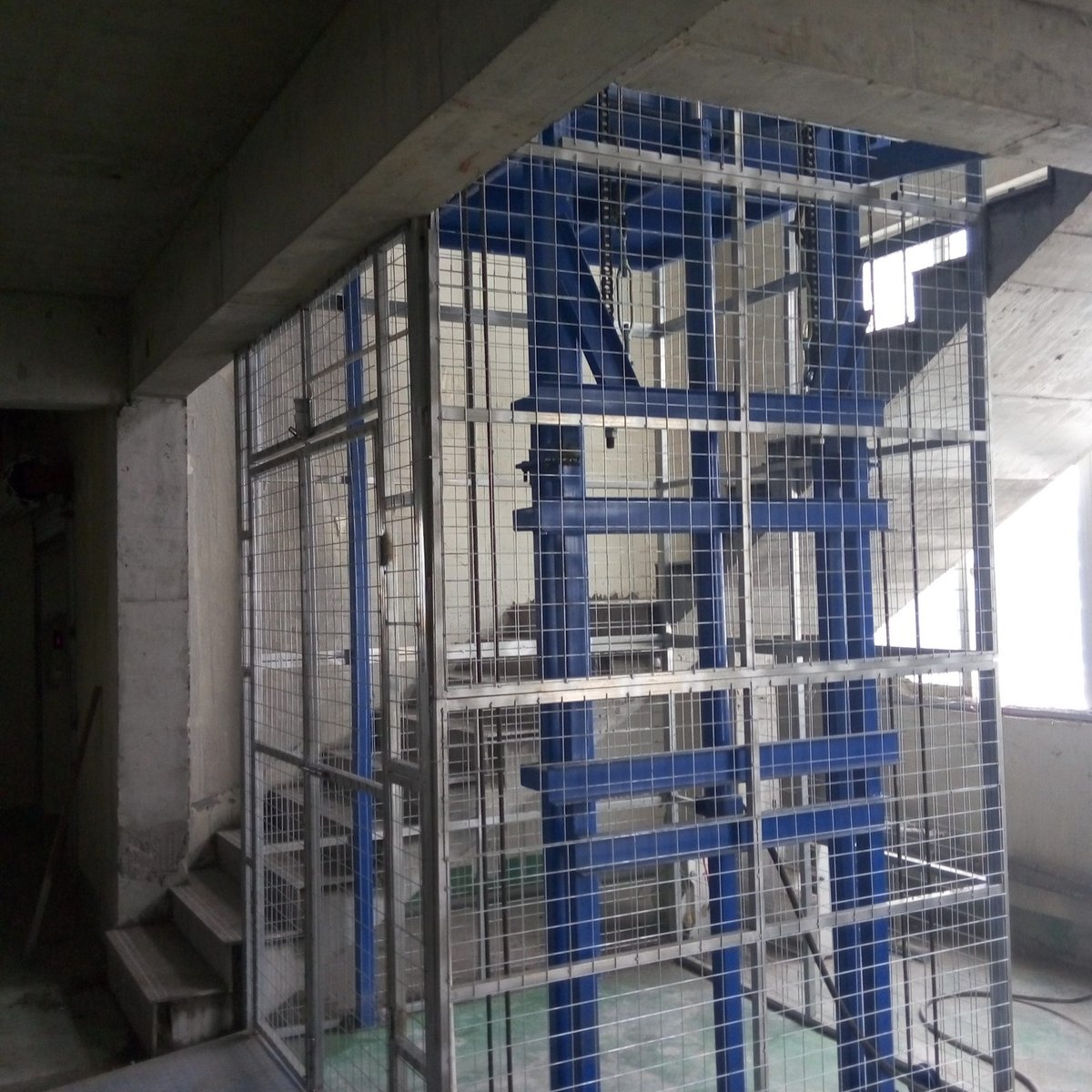
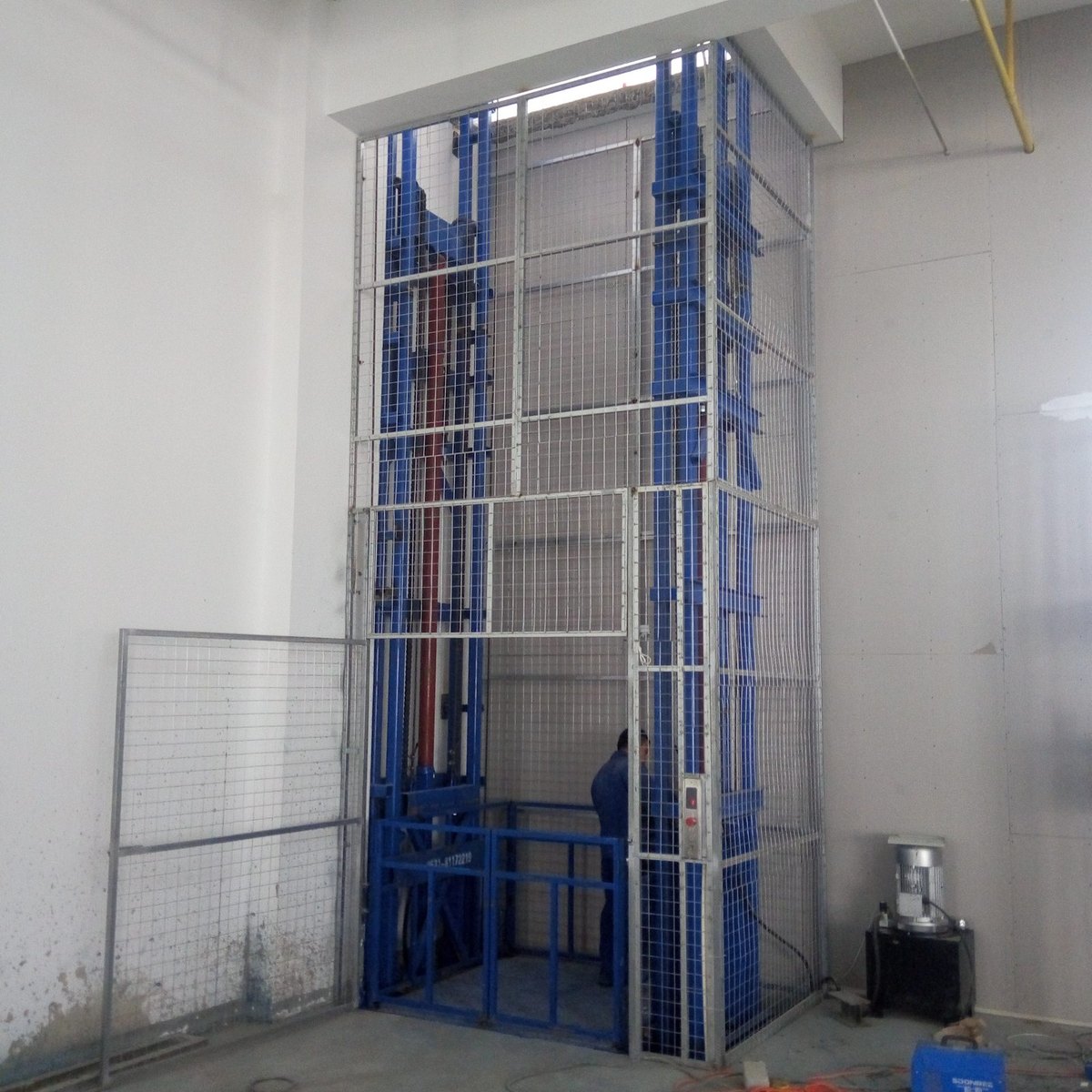
We built a 2.5 t double guide rail cargo lift for a warehouse project in Bosnia: 5 m of travel, a 1600 x 2200 mm platform, through loading on two floors and a 300 mm pit, installed by the customer’s own fitters from the drawing. A project in Ningbo needed a 1.3 x 1.3 m platform over three levels, through loading again, with additional protection mesh at the landings. Both buildings already existed; neither had a shaft, and neither needed one.
Frequently asked questions
Can a cargo lift carry people?
No. Our cargo lifts are goods-only machines, without a car, passenger safety gear or the approvals that go with carrying people. If staff have to ride between floors, a passenger or freight elevator with the relevant approvals is the right machine.
Does a cargo lift need a pit?
Our standard build for the 1600 x 2200 mm platform uses a 2200 x 2250 x 300 mm pit. Where the floor cannot be cut, a pitless version is available and the lower level is served over a ramp. Compared with the deep pit and machine room a freight elevator needs, it is a small piece of building work.
Which one costs more?
A rail cargo lift is a fraction of a shaft installation, because there is no shaft, no machine room and no specialist lift contractor. We do not publish prices, because the answer depends on the travel, the platform, the capacity and the building; send us those figures and we will quote the machine against both options.
Next step
Tell us the goods, the floors, the building and whether people have to ride, and we will say which machine suits and what it needs from the building. Start from the cargo lift range or the double guide rail cargo lift, read freight elevator dimensions and capacity explained, and for the installation sequence see a two floor cargo lift installed in an existing building.