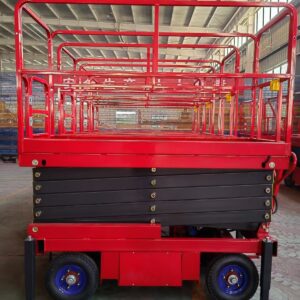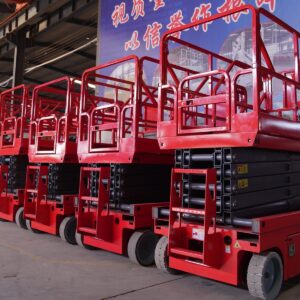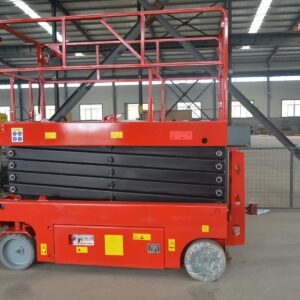
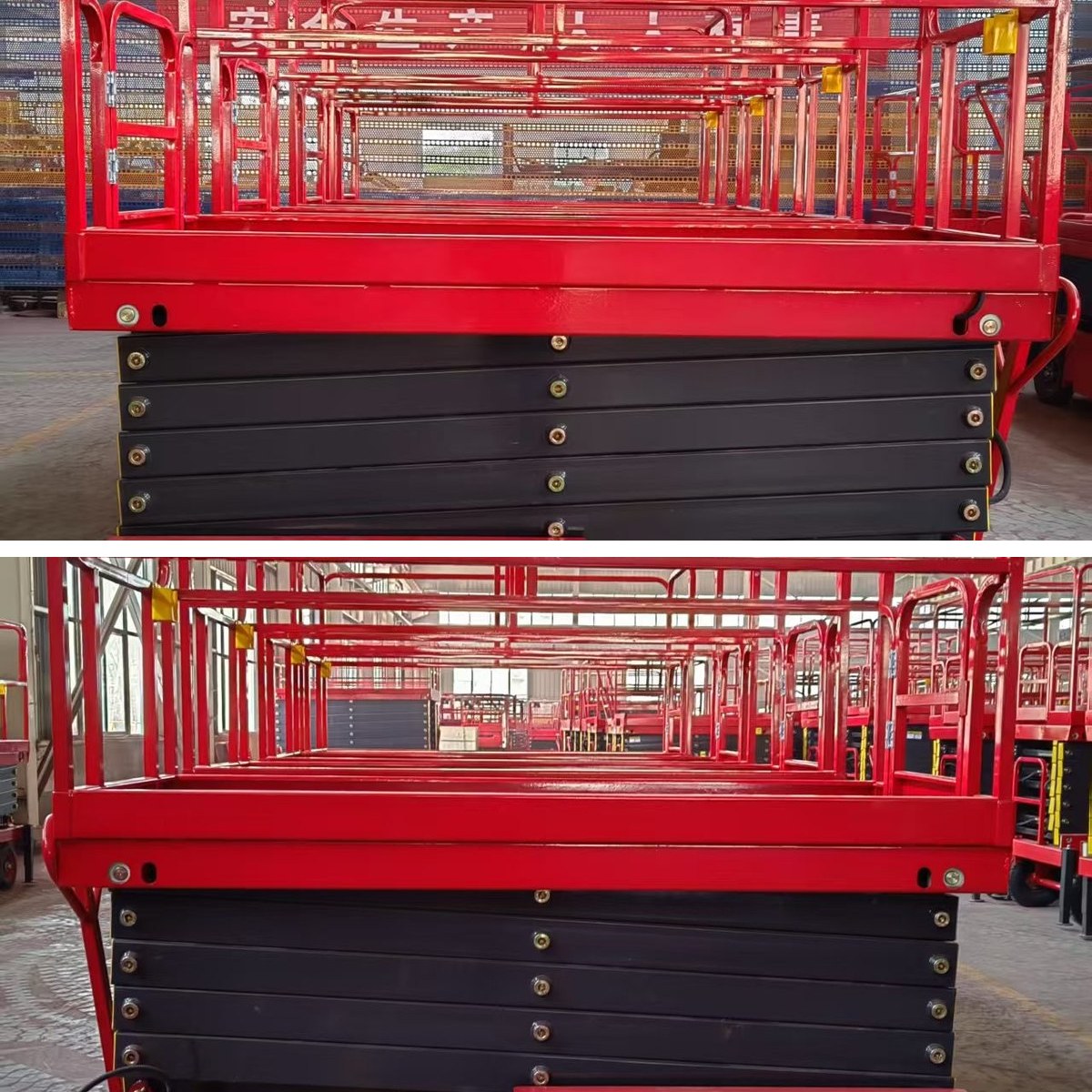
A mobile scissor lift is one of the simplest machines on a site: a frame, four wheels, four outriggers, a scissor stack and a platform on mains power. That simplicity is exactly why the setup gets rushed. The machine does not fail because the hydraulics are complicated; it fails because somebody raised it with one outrigger on a soft patch, or stood on the top rail to reach the last metre. This is the setup routine that keeps the machine where it belongs – under the work, with all four feet on the ground.
What setting up actually involves
Four steps, in this order. Push the machine to the work by hand. Extend all four outriggers onto firm ground. Connect it to a supply that can carry the power unit. Then check the platform, the guardrail and the load before anyone steps on. Everything else in this guide is detail on those four steps.
Step one: the ground and the outriggers
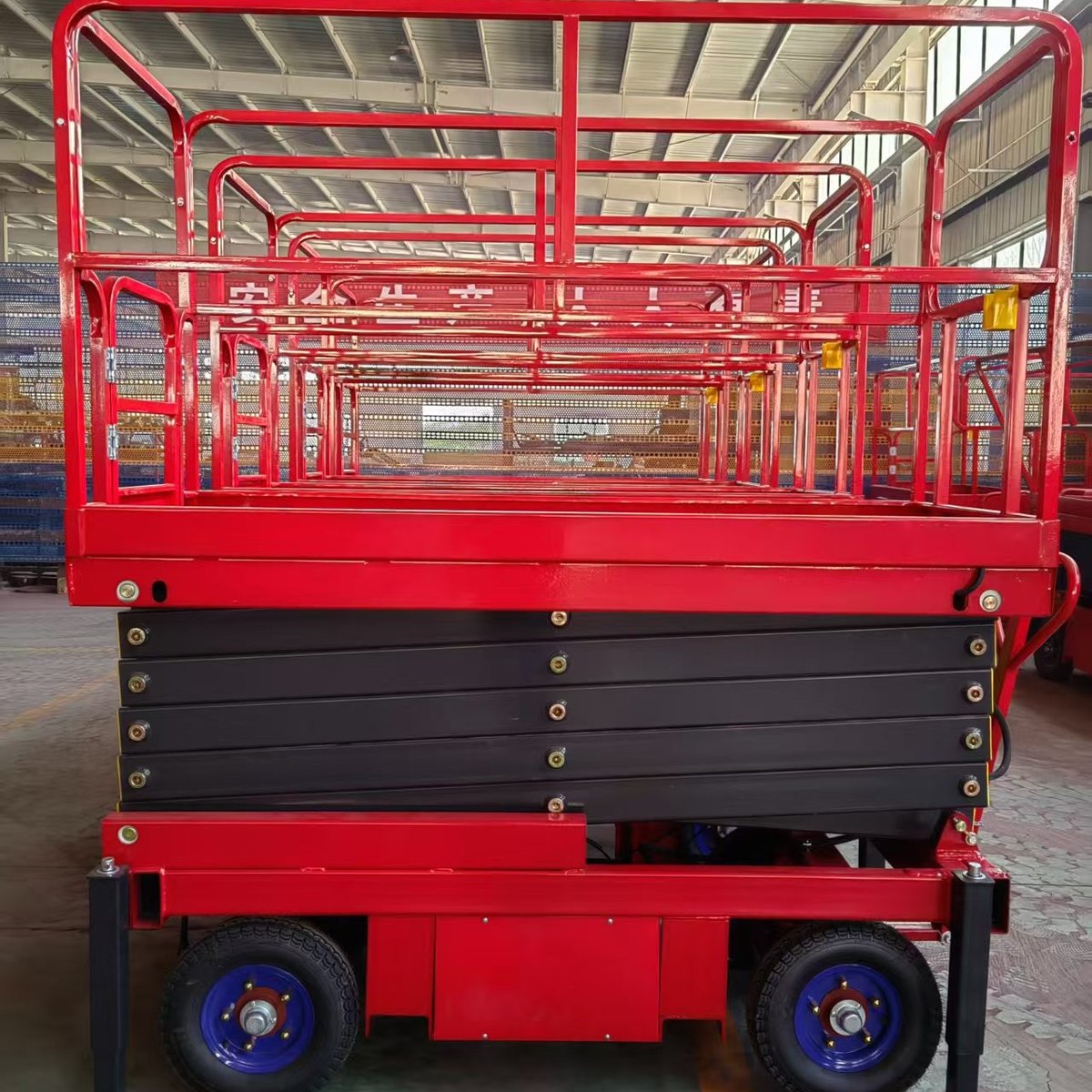
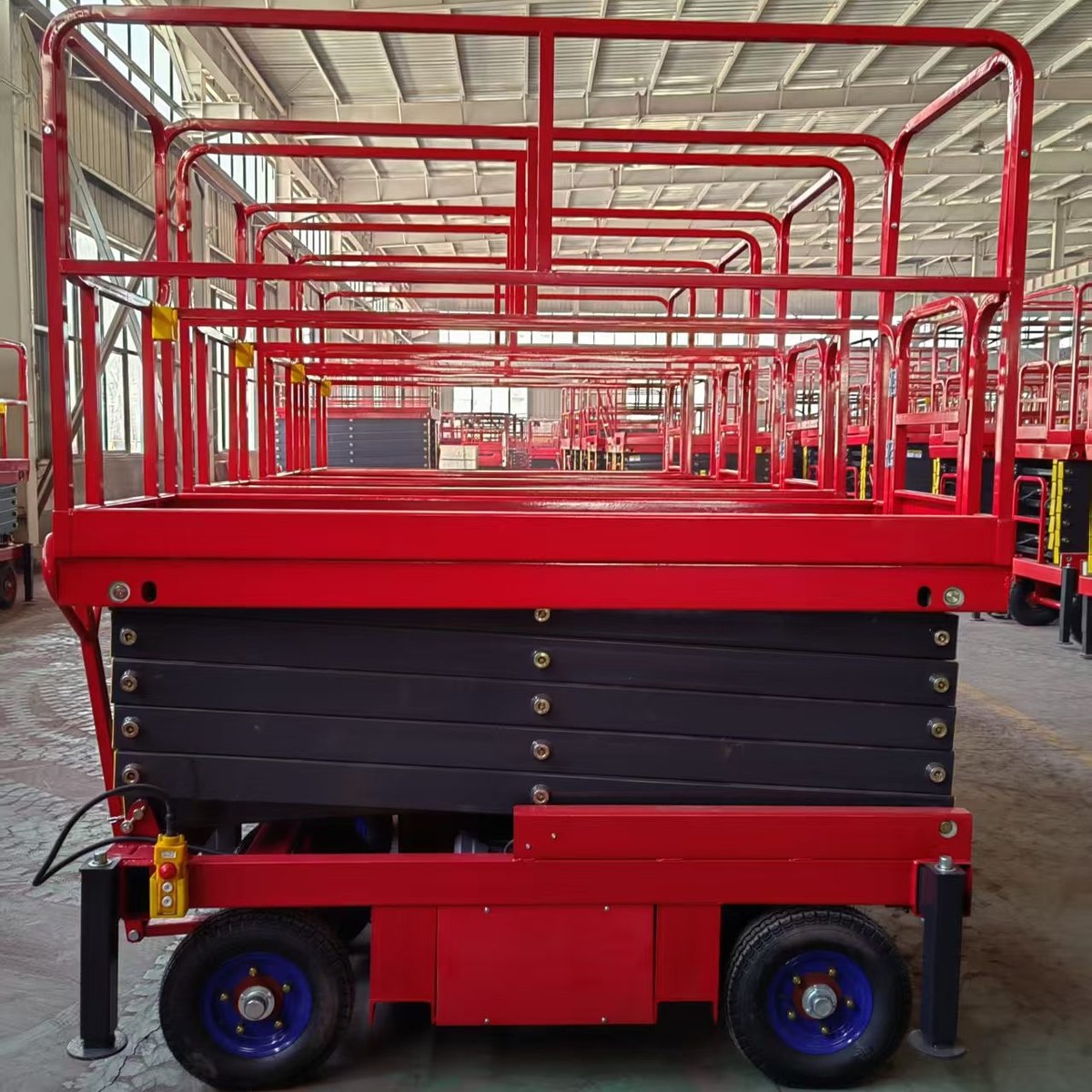
The outriggers are what make a 500 kg platform stable at 10 m, and they only work if all four are down and loaded. Put them on a level, firm surface, with a pad under any foot that sits on tiles or asphalt in warm weather. A machine that is level on its tyres is not necessarily level on its outriggers, and it is the outriggers that carry the load once the platform rises.
Soft ground, gravel, a suspended floor with a void under it, or a slope are all reasons to move the machine somewhere else rather than to block it up. A mobile scissor lift is an indoor machine on solid floor: it is not a rough terrain unit and it has no place on a building site ramp.
Step two: the supply
These lifts run on 220 V single phase up to 10 m and 380 V three phase above that, with a power unit of 1.5 kW on the smallest model and 2.2 kW on the 10 m machine. Use a cable rated for that load and short enough that the voltage does not sag when the pump starts, keep the plug and socket out of any puddle, and never run the machine from a damaged lead. If the socket is far away, tell your electrician the model and the distance rather than adding another extension lead.
Step three: the platform and the load
Our mobile scissor lifts carry 500 kg up to 14 m and 300 kg on the 16 m and 18 m models. That is two people and their tools, not two people and a pallet of blocks. Keep the load inside the guardrail, spread it across the deck rather than stacking it in one corner, and never put a ladder, a step stool or a scaffold tower on the platform to gain extra height.
| Model group | Lift height | Capacity | Typical use |
|---|---|---|---|
| MP-0.5-4AC220v to MP-0.5-9AC | 4 m to 9 m | 500 kg | Maintenance at ceiling height, two people and tools |
| SJYC0.5-10AC | 10 m | 500 kg | High ceilings in workshops and halls |
| MP-0.3-11AC220V | 11 m | 300 kg | Two people, light equipment |
| SJY0.5-12-AC380V and SJYC0.5-14 | 12 m to 14 m | 500 kg | Tall halls, three-phase supply |
| MP-0.3-16AC380V and MP-0.3-18AC380V | 16 m to 18 m | 300 kg | Very high ceilings, two people with light tools |
Step four: the checks before the first lift
- All four outriggers down, pads in place, machine level.
- Guardrail sections locked, gate closed, platform deck dry and clear.
- Emergency stop released and tested, limit switch working at the top of the travel.
- Hydraulic oil at the level mark; the specification is No. 46 anti-wear oil.
- Cable, plug and socket sound, with no strain on the connector.
- Tyres at pressure and free of cuts; the machine rolls straight when pushed.
- Nobody under the platform, nobody on the scissor arms, and the area around the machine clear.
What the machine gives you back
The safety devices on our mobile scissor lifts are there to cover the mistakes that still happen: an emergency descent valve so a person at height can be brought down if the power fails, a relief valve for overload protection, a limit switch at the top of the travel and an emergency stop at the platform. The descent speed is adjustable, which matters when the platform is close to a ceiling, and the frame is shot blasted and powder coated so that a wet floor does not turn into a rust problem.
Frequently asked questions
Do the outriggers have to be used every time?
Yes, every time the platform is raised. They are not a parking aid: they are the base that keeps the machine stable, and the lifting capacity assumes all four are extended and loaded on firm ground.
Can a mobile scissor lift work on a slope?
No. The machine is designed for a level, firm floor. If the floor slopes, move the machine to a level area and work from there, or use a self-propelled rough terrain lift for the outdoor part of the job.
How much can the platform carry?
500 kg on the models up to 14 m, and 300 kg on the 16 m and 18 m machines. That includes the people, their tools and anything they put down on the deck, so a 300 kg model is a two-person machine with light equipment rather than a materials platform.
Next step
Send us the working height, the load, the floor you will work on and the supply you have, and we will confirm the model and the setup. Start from the mobile scissor lift range, read how the power supply decides the model, and compare it with the self-propelled electric scissor lifts if the machine has to drive itself.