Almost every complaint about an electric scissor lift starts the same way: it used to do a full day, now it does half a day. Nine times out of ten the battery is not worn out, it has been mistreated. Charging a lead-acid pack is simple, but the habits that shorten its life are just as simple to fall into. This guide covers what is in the machine, how to charge it, and how to tell a tired battery from a tired charger.
What is actually in an electric scissor lift
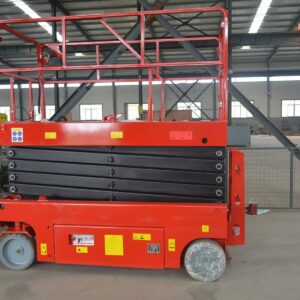
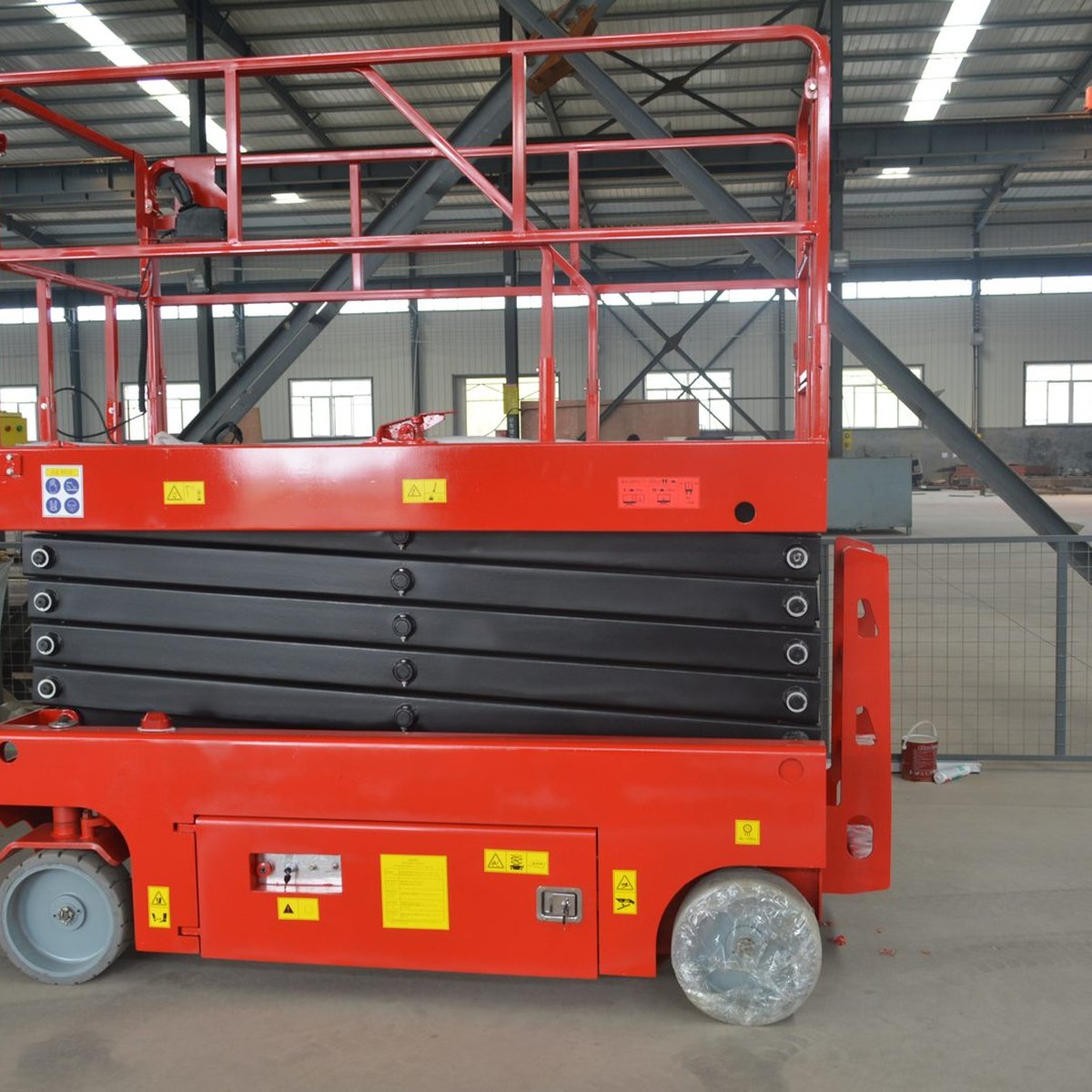
Our self-propelled scissor lifts run on a 24 V system with maintenance-free lead-acid batteries, charged by a 24 V / 30 A charger, or a 24 V / 15 A unit on the smallest 4.6 m model. The drive and lift motors draw 24 V / 3.3 kW on the 6 m to 10 m models and 24 V / 4.5 kW on the 12 m and 13.8 m models, which is why the larger machines carry the bigger pack: four 6 V / 260 Ah batteries. A charging protection system, an hour meter and a fault diagnosis system are part of the machine, and the hour meter is the tool that tells you whether anything is going wrong.
| Model | Drive and lift motor | Battery | Charger |
|---|---|---|---|
| GTJZ4.6 | AC 16 V / 1.8 kW | Lead acid, maintenance free | 24 V / 15 A |
| GTJZ06 to GTJZ10 | 24 V / 3.3 kW | Lead acid, maintenance free | 24 V / 30 A |
| GTJZ12 and GTJZ14 | 24 V / 4.5 kW | 4 x 6 V / 260 Ah, lead acid, maintenance free | 24 V / 30 A |
Why depth of discharge decides battery life
A lead-acid battery is rated for a number of cycles, and a cycle is not a charge: it is a discharge. Running a pack down to the last few percent costs several times the life of stopping at around half. That is the whole reason a scissor lift that is plugged in during every break lasts years longer than one that is run flat and charged overnight.
Three habits do most of the damage. Leaving the machine discharged for days, which lets the plates sulphate while it stands. Charging in a place that is too hot or too cold, because both change how the pack accepts charge. And overloading the platform, which pulls more current out of the battery on every lift than the machine was designed for.
A charging routine that works
| When | What to do | Why it matters |
|---|---|---|
| Every break | Plug in if the machine is below about half charge | Shallow cycles are what a lead-acid pack is happiest with |
| End of shift | Charge to full and let the charger finish its cycle | A discharged pack left standing sulphates |
| Weekly | Look at the terminals and the charger cables | Loose or corroded terminals cost voltage and heat |
| Monthly | Record hours worked per charge in the log | The trend tells you a pack is ageing before it fails |
| Long idle period | Charge fully, disconnect as the manual instructs, store dry | A pack stored flat may never come back |
| Annually | Check the pack and charger with a battery specialist | Catches a weak cell before it takes the others with it |
The numbers to watch on our machines
The hour meter is the cheapest diagnostic tool on the machine. Record the hours worked per charge when the lift is new, then compare. A steady fall in hours per charge, with the same work and the same charger, points to the pack; a charger that runs hot or never reaches the end of its cycle points to the charger; a machine that lifts slowly but still works a full day points to the motor or the hydraulics rather than the battery.
Four symptoms and what they usually mean
- Working time falling slowly over months. Age and cycle count in the pack. A capacity check at a battery specialist will confirm it before you buy a replacement.
- Working time falling suddenly. Look for a charger that failed part way, a loose or corroded terminal, or a cell that has failed inside one battery of the four.
- Lifting slow, driving normal. Usually not the battery: check the hydraulic oil and the pump before suspecting the pack.
- Charger hot, cables warm, or the charge never finishing. Stop and have the charger checked. A charger that overcharges will boil a sealed pack and end its life in weeks rather than years.
Frequently asked questions
How long does one charge last?
It depends entirely on the duty cycle, which is why we do not quote a figure in hours. Lifting draws far more current than driving, so a machine working at height all day uses its pack much faster than one moving along an aisle. Record hours per charge with the hour meter from the first week: after that your own number is the only figure that means anything on your site.
Can we top up the battery between jobs?
Yes, and on a lead-acid pack it is better than waiting for the machine to run flat. Plugging in over a lunch break keeps the depth of discharge shallow, which is exactly what the pack wants. What you should not do is leave the machine at the end of a shift partially discharged for a week, and you should always finish a charge cycle rather than pulling the plug halfway through.
Do we need a special power point?
The charger that ships with the machine is a 24 V / 30 A unit, or 24 V / 15 A on the 4.6 m model, and it plugs into a normal single-phase point of the type given in the manual. Tell us your site voltage and where the machine will be parked before we ship, because the charging point, the parking position and the length of the cable all have to suit the way your team parks and charges the machine every day.

Next step
If a machine in your fleet is losing working time, send us its model, its age, the hours on the meter and what the charger does at the end of a cycle. We will tell you whether to test the pack, the charger or the machine, and which spare parts to keep on the shelf. Start from the self-propelled electric scissor lift range, compare the mobile scissor lifts and the articulated boom lifts, and for the wider cost picture read battery or diesel aerial platform running cost compared.