A mobile scissor lift with no battery sounds like a contradiction: every electric lift needs power from somewhere. The difference is where the power comes from while it works. A battery machine carries its energy in a pack and charges between shifts; a mains machine takes it from a socket through a cable while the platform is in the air. This guide explains how that works, what it changes, and where the mains version is the better machine.
How a mains scissor lift lifts
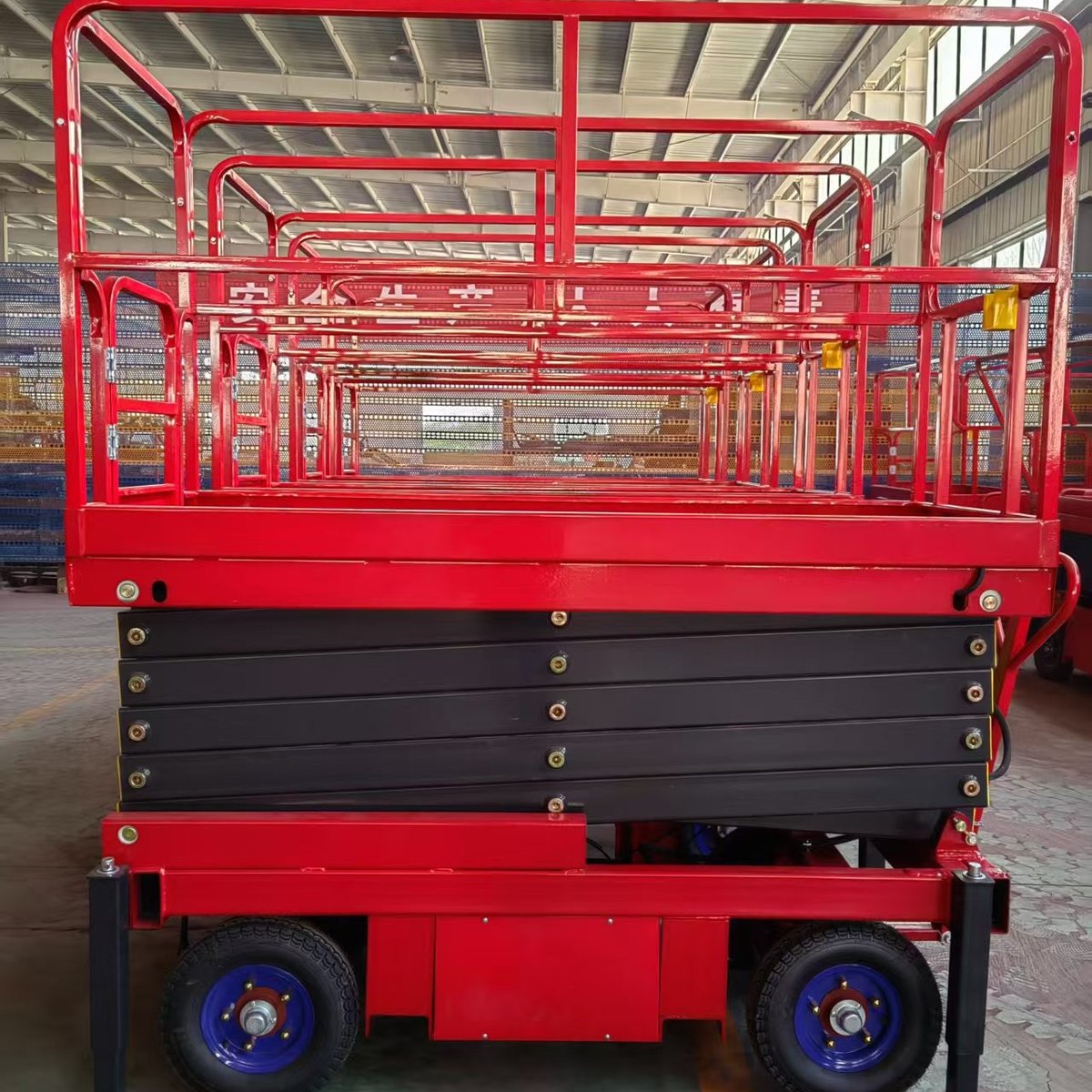
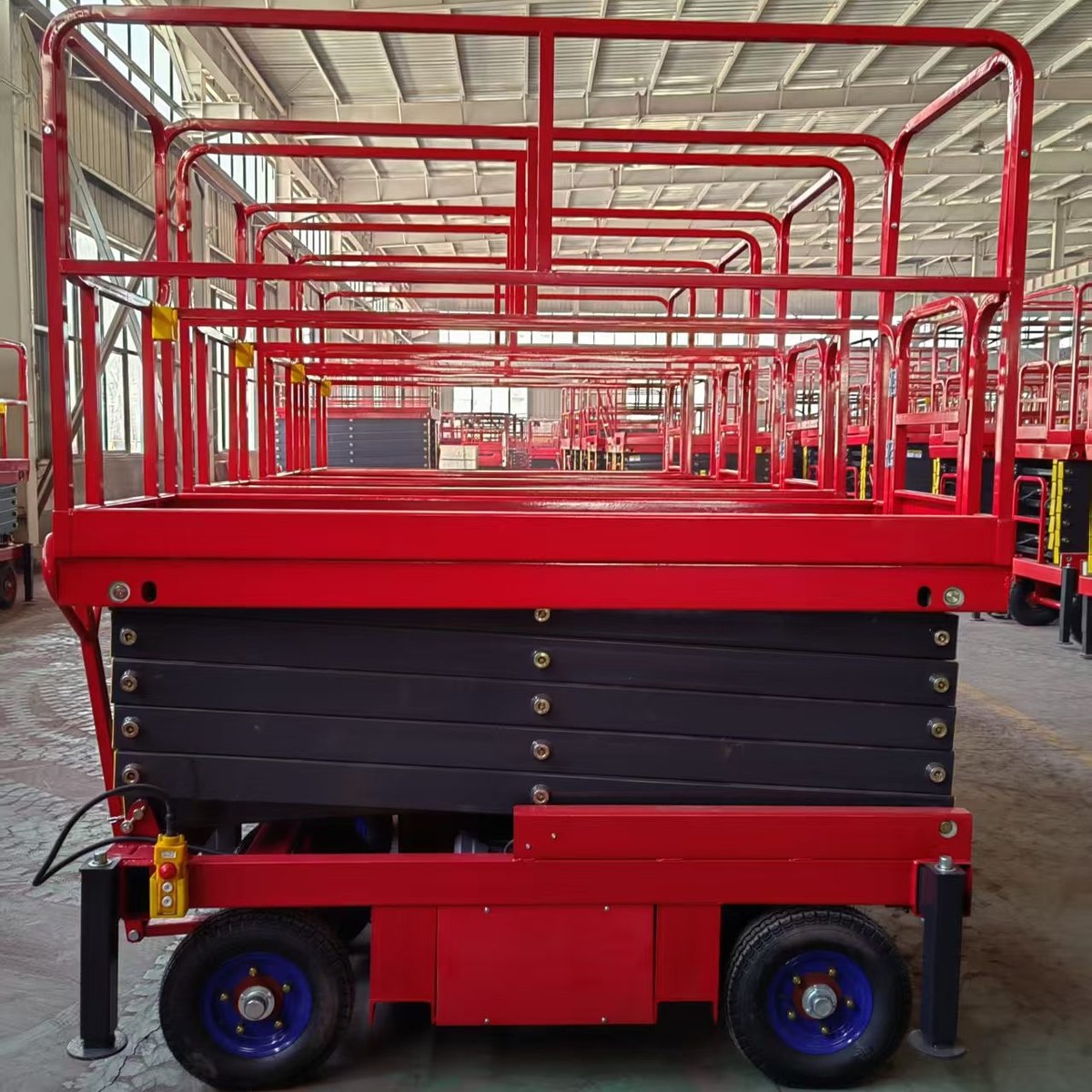
The machine is pushed into position by hand, the outriggers are extended, and a cable connects it to the site supply. Inside the chassis, a power unit of 1.5 kW on the 4 m model up to 2.2 kW on the 10 m model drives a hydraulic pump. The pump sends oil to an HSG70/45 cylinder with a chrome plated rod, and the scissor arms – 100 x 50 x 3.75 mm or 120 x 60 x 3.75 mm rectangular tube depending on the model – open to raise the platform at 4 to 6 m per minute, with an adjustable descent.
The control circuit runs at a safe 24 V, the hydraulic oil is No. 46 anti-wear oil, and the platform is surrounded by a 1.1 m guardrail on a 30 x 30 mm frame. In other words, the lift mechanism is the same as a battery machine’s; the difference is that the pump motor is fed from the wall instead of from a battery.
What you gain by leaving the battery out
- No charging routine. There is no pack to charge, no charger to store and no shift planning around battery state.
- No battery to replace. The largest wear item on a battery machine disappears, and with it the long-term cost of a pack replacement.
- Less weight. The machine carries no battery pack, which makes it easier to push and easier to move into a goods lift.
- Constant power. The lift does not slow down as the day goes on, because the supply does not run down.
What you give up
There is a cable, and that is the whole trade. The machine has to work where a socket exists, the cable has to be rated for the power unit and short enough that the voltage does not sag when the pump starts, and the cable has to be routed so nobody drives over it. For a single workshop, a factory bay or a hall where the lift works near a fixed point, that is no problem. For a site where the machine moves hundreds of metres a day, a battery machine is the better answer.
The range, in numbers
| Model group | Lift height | Capacity | Power supply |
|---|---|---|---|
| MP-0.5-4AC220v to MP-0.5-9AC | 4 m to 9 m | 500 kg | AC 220 V |
| SJYC0.5-10AC | 10 m | 500 kg | AC 220 V |
| MP-0.3-11AC220V | 11 m | 300 kg | AC 220 V |
| SJY0.5-12-AC380V and SJYC0.5-14 | 12 m to 14 m | 500 kg | AC 380 V |
| MP-0.3-16AC380V and MP-0.3-18AC380V | 16 m to 18 m | 300 kg | AC 380 V |
Working safely from a cable
- Use a cable rated for the power unit, and check the plug and socket before every shift.
- Keep the connector out of water and off the floor where a trolley can run over it.
- Extend all four outriggers onto firm, level ground before raising.
- Test the emergency stop and the limit switch at the start of the day.
- Never move the machine with the platform raised, and never move it by pulling the cable.
Where the mains machine wins
The mains scissor lift is at its best where the work is in one place: a workshop ceiling, a factory bay, a hall with a socket on the wall, a warehouse aisle. It is also the machine to choose when the lift is used occasionally, because a battery that sits unused for months is a battery that needs attention, while a cable machine is ready whenever the socket is. Tell us how far the machine travels in a day and how often it is used; both answers point clearly to one of the two types.
Frequently asked questions
Does a mains scissor lift need a special supply?
The models up to 11 m run on single phase 220 V; the 12 m to 18 m models need 380 V three phase. The power unit is 1.5 kW at 4 m and 2.2 kW at 10 m, so the cable has to be sized for that rather than for a domestic appliance.
Can it work outdoors?
It is an indoor machine on solid floor. Outdoors the ground has to be firm and level for the outriggers, and the cable and socket have to be protected from water. For yards and rough ground a self-propelled rough terrain lift is the right machine.
What happens if the power fails at height?
The hydraulic system holds the platform, and the emergency descent valve lets a trained operator bring it down. That valve is part of the safety set on every machine, along with the relief valve for overload protection, the limit switch and the emergency stop.
Next step
Tell us the working height, the load, the floor and where the nearest socket is, and we will confirm the model and the cable requirement. Start from the mobile scissor lift range, read how to set up and use a mobile scissor lift safely, and compare it with the self-propelled battery scissor lifts before you decide.