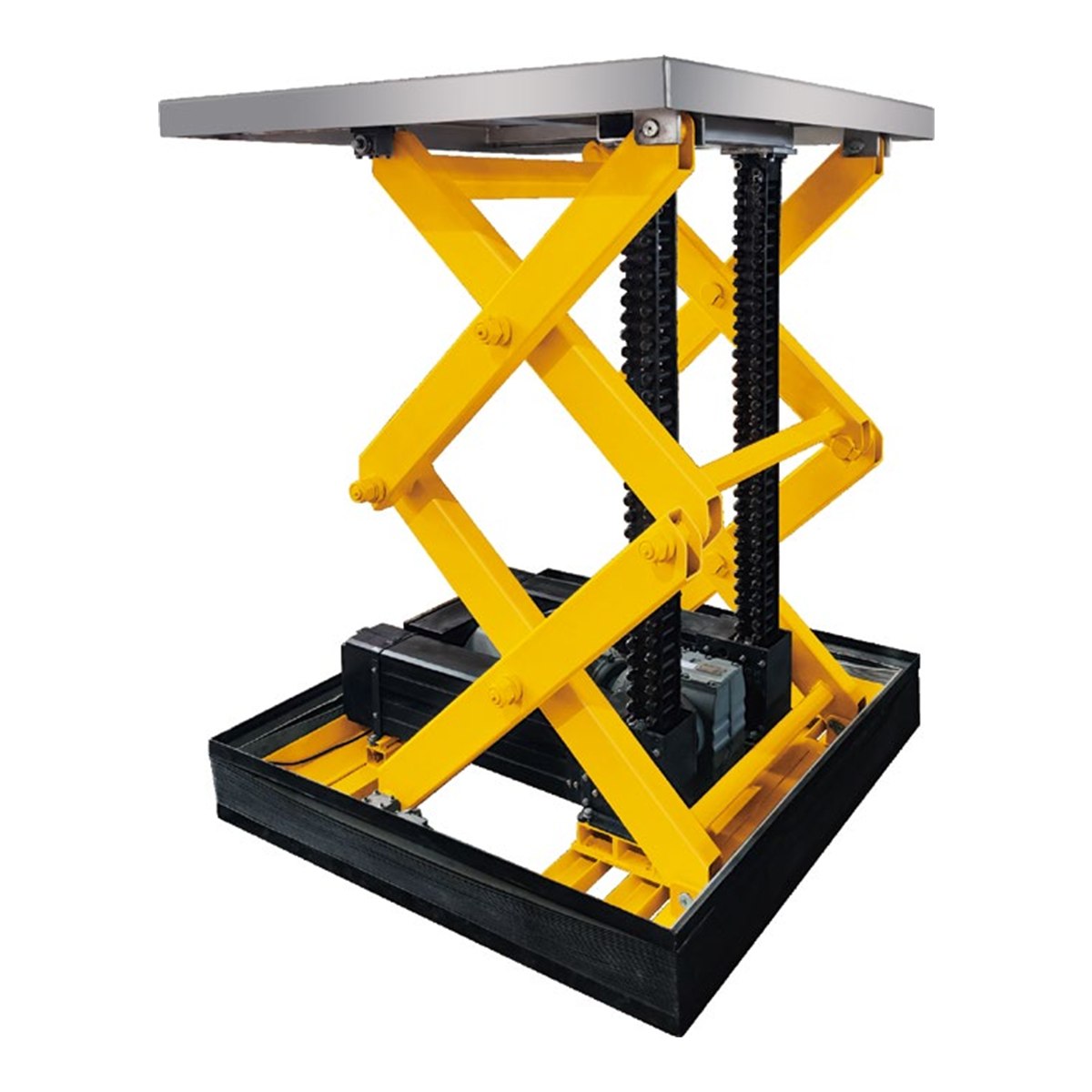
A stationary lift table is fixed to the floor, a machine base or a production cell and raises a load to the height where the next operation takes place. The useful buying decision is therefore a combination of load, platform dimensions, vertical travel and operating frequency. A table that handles the weight but not the deck size, or reaches the height but cannot survive the work cycle, is still the wrong choice.
What does a stationary lift table need to do?
Start with the work cycle rather than the model name. Is the table loaded by a pallet truck, overhead crane, conveyor or by hand? Does it rise once per shift or hundreds of times per day? Does it only position a workpiece, or does it also need powered travel along a production line? These answers decide whether a low-profile hydraulic table, electric screw platform or rigid chain lift is the appropriate starting point.
The table also has to be fixed safely. The base, floor or machine frame must carry the table, load and operating forces. A low closed height can reduce the amount of floor preparation needed, but it does not remove the requirement to check the supporting slab and the route used to place the load.
How do capacity and load position work together?
Capacity is the total load the platform is designed to carry, including the fixture, pallet, container or tooling. Do not add a fixture or an offset load after selecting the table without reviewing the rating and load centre. A wide or unbalanced load can matter even when its total weight is below the nominal capacity.
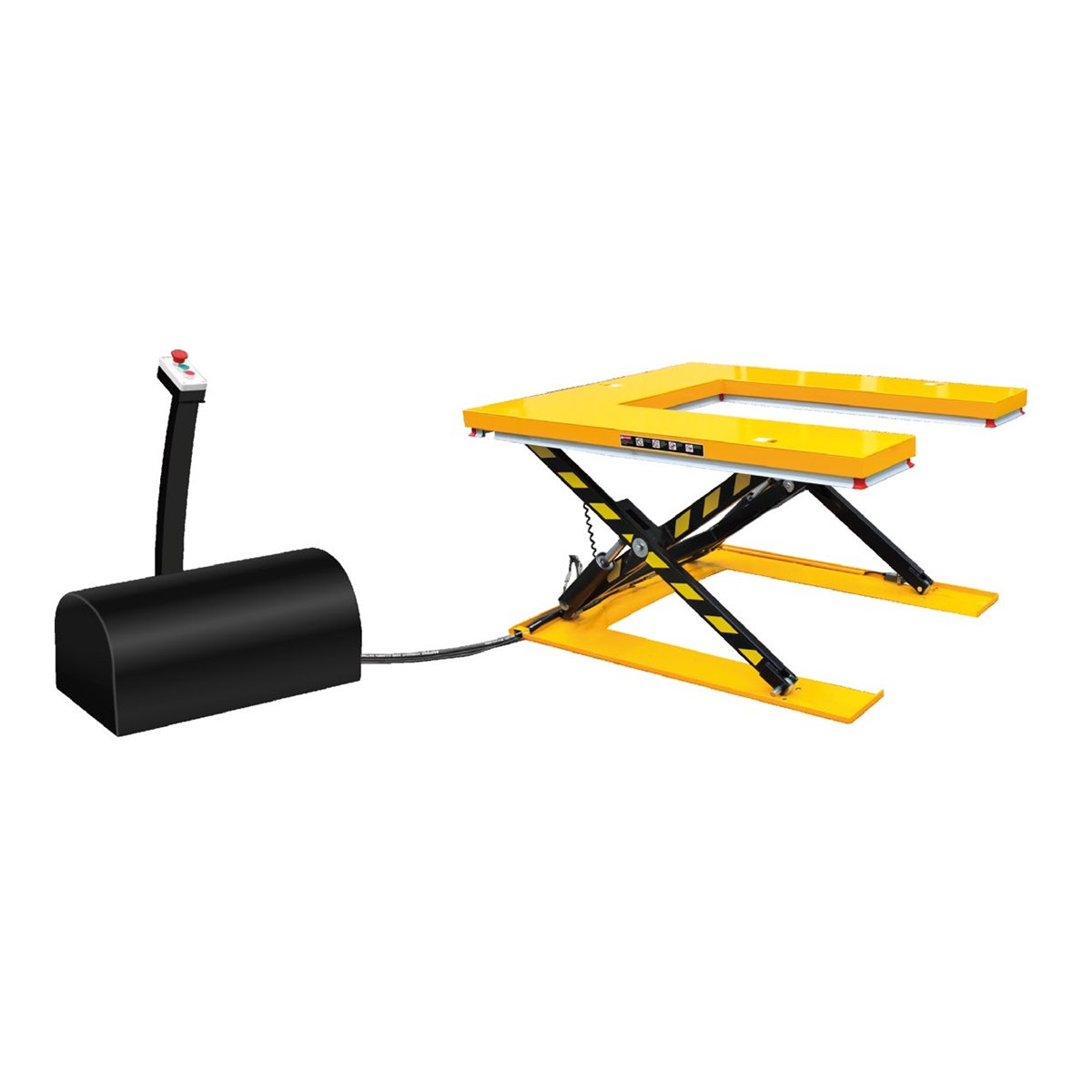
Our low-profile DDG and DUG range shows how the deck changes with capacity. DDG1000 is listed for 1,000 kg with a 1450 x 1140 mm table. DDG1500 and DDG2000 are rated for 1,500 kg and 2,000 kg with a 1600 x 1200 mm table. The U-shaped DUG versions preserve a 1080 x 580 mm or 1194 x 580 mm opening for pallet-truck access.
How much vertical travel is required?
Measure the pick-up height and the delivery height separately. The low-profile HL1000 and HL1500 close to 35 mm and rise to 810 mm. DDG1000 reaches 860 mm from an 85 mm closed height, while the larger DDG1500 and DDG2000 start at 105 mm with the same 860 mm maximum.
When the task requires a compact powered positioning platform, the DSG electric screw lift table lists a 430 mm minimum height, 600 mm maximum height, 1400 x 1400 mm table and 4,000 kg capacity. Its vertical travel is 170 mm. That short stroke can suit a production fixture where the table only needs to make a precise final height adjustment, rather than lift a pallet from floor level.
Which drive arrangement matches the duty?
A low-profile electric table is useful where the pallet or skid must be picked up close to floor level. The DSG combines a screw-driven platform with a listed travel speed of 3,000 mm/min and a lifting speed of 150 mm/min. A rigid chain lift is a different option for long, repeated vertical movement: the DGC is listed to 10,000 kg and 10,000 mm travel, with 0-300 mm/s speed and repeat positioning up to 1 mm.
{table(
(“Selection point”, “Low-profile electric table”, “Electric screw lift table”, “Rigid chain lift”),
[
(“Listed capacity”, “DDG / DUG / HL: 1,000-2,000 kg”, “DSG: 4,000 kg”, “DGC: up to 10,000 kg”),
(“Typical height range”, “35-860 mm depending on model”, “430-600 mm”, “500 mm minimum; up to 10,000 mm travel”),
(“Platform information”, “1450 x 1140 mm to 1600 x 1200 mm”, “1400 x 1400 mm”, “Custom platform”),
(“Movement data”, “Stationary lifting table”, “150 mm/min lift; 3,000 mm/min travel”, “0-300 mm/s lifting speed”),
(“Useful starting point”, “Pallet handling close to floor level”, “Compact powered production positioning”, “Long-travel, high-cycle vertical positioning”),
],
)}
What does duty cycle change?
Frequent lifting makes maintenance access and repeatability more important. The DGC rigid chain system is listed with a maximum service life of 2 million lifting cycles, repeat positioning accuracy up to 1 mm, no routine lubrication and no oil pollution. Those figures should be read as the catalogue’s design data; the actual duty cycle still has to include the load, travel, starting frequency and working environment.
For a low-profile table, consider how often the platform is raised, how long it stays at height and how the pallet enters and leaves. A pallet truck that remains partly over the deck can change the effective load position. For a screw platform, the fixture, process forces and required stopping accuracy need to be included in the cycle description.

What changes when the platform is very wide?
Deck dimensions have to be checked against the load footprint and the support points, not only the rated capacity. For a Dezhou wide-platform project, we configured a 20,000 kg stationary table with a 13,000 x 3,000 mm deck, 1,250-1,550 mm operating height and a 5 mm plate. The large deck and short lifting range show why a standard catalogue model cannot simply be scaled by changing the capacity number.
The table base, scissor or lifting structure, floor loading and load distribution all have to be reviewed together. A wide platform should have a defined support pattern and a clear operating area, especially if the load is placed by crane or if only part of the deck is occupied.
What should be checked at the work position?
- The loaded weight, fixture weight and centre of gravity.
- Minimum and maximum deck height at the actual loading and delivery points.
- Deck size, U-opening or roller requirements.
- Use frequency, holding time and number of movements per shift.
- Floor support, fixing points and clearance around the moving platform.
- Operator access, guards and the method used to transfer the load.
Frequently asked questions
How do I choose the capacity of a stationary lift table?
Add the load, fixture, pallet or container and any tooling carried by the platform. Then check the load centre and load distribution. A table rated for the total mass can still be unsuitable if the load is overhung or concentrated outside the intended support area.
Do I need a pit for a low-profile lift table?
The HL1000 and HL1500 are listed with a 35 mm closed height and described as suitable for pit-free installation. The final floor detail still depends on the model, the loading method and the approved drawing. Do not excavate or set the finished floor level from the catalogue height alone.
When is a rigid chain lift preferable to a scissor table?
The DGC is listed for high-cycle vertical positioning with travel up to 10,000 mm and repeat accuracy up to 1 mm. A low-profile DDG or DUG table is better suited to loading a pallet near floor level. The choice follows the required travel, cycle count, platform and building interface.
Next step
Send the load drawing, fixture weight, platform size, pick-up and delivery heights, cycle count and floor information. Start with the low-profile electric lift table range, the electric screw lift table or the rigid chain lift, and read how a 20 t fixed scissor lift table is designed for a wide-platform example.