Both machines lift a person to overhead work, and both are sold by working height, which is why buyers so often compare the wrong numbers. The real difference is not how high they reach. It is whether the platform has to arrive from directly below the work point, or whether it can be reached in from a position the machine is actually able to stand in.
What is the difference between a scissor lift and a boom lift?
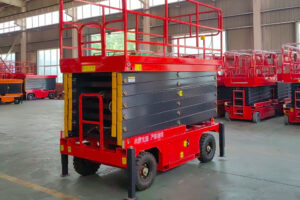
A scissor lift raises its platform straight up on crossed steel arms. The deck stays within the footprint of the chassis, so the machine has to be positioned under the work point and the operator works above the base. Loading is spread over a wide, flat deck, which is why scissor lifts carry more weight and more people per square metre than boom lifts of the same height.
A boom lift raises the platform on an arm, either a folding articulated jib or a straight telescopic boom. The chassis can stand back from the work point and the arm reaches the platform into position, over racking, pipework or a machine that cannot be moved. That reach is bought with a heavier base and a smaller basket.
The practical consequence is simple: work directly above open floor favours a scissor lift, and work behind an obstacle or above sixteen metres favours a boom lift.
When a scissor lift is the right machine
Our self-propelled scissor lift range covers platform heights from 4.6 m to 13.8 m, which means working heights of about 6.6 m to 15.8 m. Rated load is 200 kg to 450 kg, and the platform is 2.27 m by 1.12 m with a 0.9 m extension deck that slides out to reach over a racking row or a machine.
- Choose a scissor lift for repetitive work along a straight run: lighting, sprinkler heads, cable trays, ducting, ceilings and racking faces.
- Choose it when the deck has to carry two people, their tools and materials at the same time.
- Choose it indoors, where the battery drive and non-marking tyres matter and no exhaust fumes are allowed.
- Choose the narrow 0.85 m chassis when the route in runs through a standard internal doorway.
Machine weight across the range runs from 870 kg for the 4.6 m model to 3,570 kg for the 13.8 m model, which is light enough for most mezzanine floors and goods lifts.
When a boom lift is the right machine
Our articulated boom lifts run from 16.58 m to 22 m working height. The number that decides whether they are needed is not the height, it is the up-and-over clearance: 7.86 m on the 16 m and 18 m models, and 8.54 m on the 20 m and 22 m models. That is the height of obstacle the arm can pass over while still dropping the platform behind it. Maximum working radius is 8.45 m to 12.9 m.
- Choose a boom lift when the platform has to arrive behind racking, above pipework, or on the far side of an obstruction.
- Choose it for work above 16 m, where a scissor lift would need a much larger and heavier base.
- Choose the four-wheel-drive, 45% gradeability chassis for yards, sites and uneven ground.
- Choose battery or lithium power for indoor use, and diesel for long outdoor shifts on rough ground.
Platform capacity is 250 kg, or 256 kg / 350 kg on the 16 m and 18 m models, and the basket is smaller than a scissor deck by design. A 22 m machine weighs around 9,000 kg and stows to 8.9 m long, 2.45 m wide and 2.53 m high, so check the route in and the floor it will travel over.
Four questions that settle the choice
- Is the work point directly above floor the machine can stand on? If yes, a scissor lift will do the job for less money and with a bigger deck. If the floor space beneath the work point is occupied, you need a boom.
- Is there anything between the machine and the work point? Racking, machinery, a parapet or pipework means an articulating boom, because a scissor platform cannot pass over an obstacle.
- How high do you actually need to reach? Below about 14 m, scissor lifts are cheaper, simpler and carry more. Above 16 m, the boom becomes the practical choice.
- What can the ground or floor take? A 13.8 m scissor lift weighs 3,570 kg; a 22 m boom lift weighs about 9,000 kg. Check the doorway width, the point load on the floor and the slope on the route.
Scissor, articulated boom or telescopic boom
| Scissor lift | Articulated boom lift | Telescopic boom lift | |
|---|---|---|---|
| How the platform arrives | Straight up, from directly below | Reaches up and over an obstacle | Straight line, maximum reach |
| Working height | 6.6 m to 15.8 m | 16.58 m to 22 m | 22.9 m to 28.8 m |
| Platform | 2.27 x 1.12 m with 0.9 m extension | 1.83 x 0.76 m or 2.4 x 0.9 m | Long basket on a straight boom |
| Rated load | 200 kg to 450 kg | 250 kg to 350 kg | On request |
| Machine weight | 870 kg to 3,570 kg | 6,850 kg to 9,000 kg | Higher again |
| Indoor use | Battery drive, non-marking tyres | Lithium version, no fumes | Usually outdoor |
| Typical job | Lighting, sprinklers, ducting, racking faces | Maintenance behind pipework and racking, cladding, steelwork | High reach over open ground |
| Link | Electric scissor lift | Articulated boom lift | Available on request |
The mistake buyers make: buying height instead of access
Most enquiries start with a height and a budget, and most of the disappointment comes from choosing on the height alone. A machine that reaches the right height but cannot be positioned where the work is becomes a rental that sits in the yard.
Send us the work point rather than the number: a photograph of the area, the height to be reached, what the machine can stand on, and what is in between. Those four things decide the machine far more reliably than a catalogue height.
Frequently asked questions
Can a scissor lift be used outdoors?
Yes, on firm and level ground. Specify rough-terrain tyres and an outdoor finish, and follow the wind speed limit that applies in your country. For uneven ground or long outdoor shifts, the four-wheel-drive boom lift is the more productive machine.
Do I need both machines?
Many sites end up with one of each, and the split is usually by task rather than by height. The scissor lift does the long runs of repeated work on flat floors inside the building, and the boom lift handles the awkward positions, the high work and the outdoor structure.
Which one costs less to run?
For the same working height, a scissor lift is the lighter and simpler machine, so it uses less energy and costs less to maintain. A boom lift costs more to buy, more to move and more to service, and it earns that back by reaching work the scissor lift cannot get to at all.
Next step
Tell us the height you need to reach, what the machine can stand on, and what sits between the machine and the work point. We will tell you which machine fits, and if both would do the job we will quote both so you can see the difference. See our electric scissor lift range and our articulated boom lifts for the full specifications.