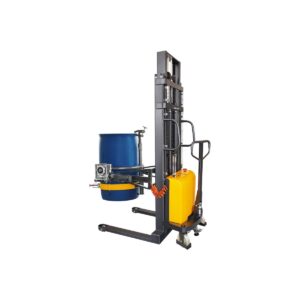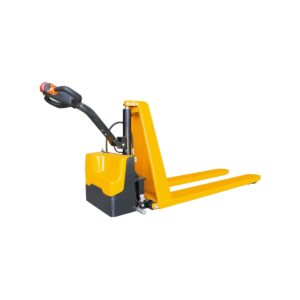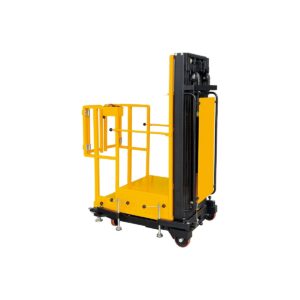
A semi-electric stacker and a full-electric stacker both use power to raise a pallet, but they remove different amounts of work from the operator. BDDJS combines electric lifting with manual travel; CDD-EJ is listed as full-electric and adds higher capacities and longer forks. Start with the route and lifting task, not the motor size.

What is the difference between semi-electric and full-electric?
BDDJS uses a 12 V electric lifting system with a 0.8 kW motor; the operator moves the stacker by hand. CDD-EJ uses a 2 x 12 V battery set and a 24 V / 0.8 kW lift system.
Semi-electric reduces lifting effort while travel remains manual. Full-electric fits when the whole handling cycle benefits from powered movement. Both remain stackers, so pallet, rack and aisle checks still control the choice.
Which stacker models and capacities are available?
| Model | Type | Load | Fork height | Fork length | Battery | Weight |
|---|---|---|---|---|---|---|
| BDDJS1100 | Semi-electric | 400 kg | 90 – 1,100 mm | 650 mm | 12 V, 52 / 65 Ah | 105 kg |
| BDDJS1300 | Semi-electric | 400 kg | 90 – 1,300 mm | 650 mm | 12 V, 52 / 65 Ah | 108 kg |
| BDDJS1500 | Semi-electric | 400 kg | 90 – 1,500 mm | 650 mm | 12 V, 52 / 65 Ah | 111 kg |
| BDDJS1700 | Semi-electric | 400 kg | 90 – 1,700 mm | 650 mm | 12 V, 52 / 65 Ah | 118 kg |
| BDDJS1800 | Semi-electric | 400 kg | 90 – 1,800 mm | 650 mm | 12 V, 52 / 65 Ah | 125 kg |
| BDDJS2000 | Semi-electric | 200 kg | 90 – 2,000 mm | 650 mm | 12 V, 52 / 65 Ah | 125 kg |
| CDD-EJ05 | Full-electric | 500 kg | 90 – 1,300 / 1,600 mm | 850 mm | 2 x 12 V, 32 Ah | Not listed |
| CDD-EJ07 | Full-electric | 700 kg | 90 – 1,300 / 1,600 mm | 1,150 mm | 2 x 12 V, 32 Ah | Not listed |
The electric stacker range uses a 90 mm lowered fork height across the listed models. The BDDJS group carries 400 kg except for the taller BDDJS2000, which is rated at 200 kg. The full-electric models increase capacity to 500 kg and 700 kg and offer 850 mm or 1,150 mm forks.
When does powered lifting alone make sense?
A BDDJS suits compact, flat routes where the operator can push the stacker from receiving to storage. Electric lifting handles repeated height changes, while manual travel keeps the machine light: listed net weight is 105 to 125 kg.
The 650 mm fork and 650 x 580 mm optional platform are compact dimensions. Check them against the actual pallet or load. If the load is too wide or the pallet needs a longer fork support, the semi-electric group is not the right starting point. The BDDJS is also load-sensitive at height: BDDJS2000 has a 2,000 mm lift but a reduced 200 kg rating.
When is a full-electric stacker a better fit?
CDD-EJ suits repeated warehouse travel, loads above BDDJS capacity or pallets needing an 850 mm or 1,150 mm fork. Both models offer 1,300 mm or 1,600 mm maximum fork height and a 90 mm lowered position.
CDD-EJ05 is rated at 500 kg and CDD-EJ07 at 700 kg. Their overall width is 550 mm or 680 mm depending on configuration. Confirm the final fork and chassis layout for the aisle, because a longer fork can increase the space required to enter the pallet and turn.
How should the required lift height be chosen?
Measure the rack beam or support height and the clearance above it. For racking, the forks must lift the pallet clear of the beam before setting it down; maximum fork height alone does not prove that the load clears every obstruction.
The BDDJS range progresses from 1,100 mm to 2,000 mm, but the highest model is a lower-capacity 200 kg version. The CDD-EJ models top out at 1,600 mm with higher 500 kg or 700 kg capacities. Compare both ratings together rather than assuming that the tallest listed model can also carry the heaviest load.

What must be checked on the pallet and rack?
- The loaded pallet weight and its centre of gravity.
- Pallet entry height, depth and condition.
- Fork length and the usable fork opening.
- Rack beam height, clear height and free lift.
- Aisle width, turning space and door openings.
- Floor joints, ramps and the surface under the wheels.
The load has to sit fully and stably on the forks. A pallet that overhangs excessively or has a damaged underside can create a handling problem even if its weight is below the rated load. Confirm the load centre allowed for the selected model and keep the load within it.
What features are listed for the range?
The product range lists a chrome-plated mast and low-effort steering on the semi-electric models, a built-in charger and emergency-stop switch. A platform and infrared sensor are listed as options, along with a steel cover and custom sizes. These features should be included in the quotation when required; the standard machine should not be assumed to include every listed option.
The platform option is useful when goods do not fit the fork arrangement or need a flat support. Send its required size, load and working height so the attachment is assessed with the chosen model rather than added later without checking capacity and stability.
What route information changes the choice?
A short, flat route with nearby storage supports manual travel. Longer movement with repeated transfers makes powered travel worth reviewing. Check stopping distance and turning space with the loaded stacker, not an empty machine. The charging point also needs a safe connection and a cable route clear of traffic.
What does a real warehouse review show?
In a smart-warehouse review in Brazil, our team started with the route and the points where goods enter picking or storage. Identify the loaded pallet, movement distance and rack height before deciding whether powered travel adds value.
How do you make the final choice?
Choose the BDDJS if the pallet fits the 650 mm fork, the load is within the relevant 200 kg or 400 kg rating, the route can be handled manually and the lift height matches the rack or support. Choose CDD-EJ for 500 kg or 700 kg loads, the longer 850 mm or 1,150 mm fork, a 1,300 mm or 1,600 mm lift and a full-electric handling cycle.
Confirm the exact pallet dimensions and height before ordering. A model that fits the load and rack without unnecessary lift is a better starting point than the tallest machine.

Frequently asked questions
Can a semi-electric stacker lift 500 kg?
The BDDJS models in this range are rated at 400 kg, except BDDJS2000 at 200 kg. CDD-EJ05 is the 500 kg option in the listed full-electric range.
Which model reaches 2,000 mm?
BDDJS2000 reaches 2,000 mm and is rated at 200 kg. The CDD-EJ models are available with 1,300 mm or 1,600 mm maximum fork height.
Does a semi-electric stacker move under power?
No. The BDDJS group has electric lifting and manual travel. The CDD-EJ models are listed as full-electric.
Next step
Send the pallet dimensions, loaded weight, rack height, aisle width, floor route and moves per shift. We can compare the BDDJS and CDD-EJ electric stacker models against the complete handling task.