A 16 metre vehicle turntable is not simply a car turntable enlarged on a drawing. The vehicle envelope, deck area, rotating support, foundation interface and access all grow together. Capacity is only one line in the specification; the project has to show where a long commercial vehicle sits, how its weight reaches the structure and how the finished turntable meets the surrounding ground.
What is a 30 t, 16 m vehicle turntable?
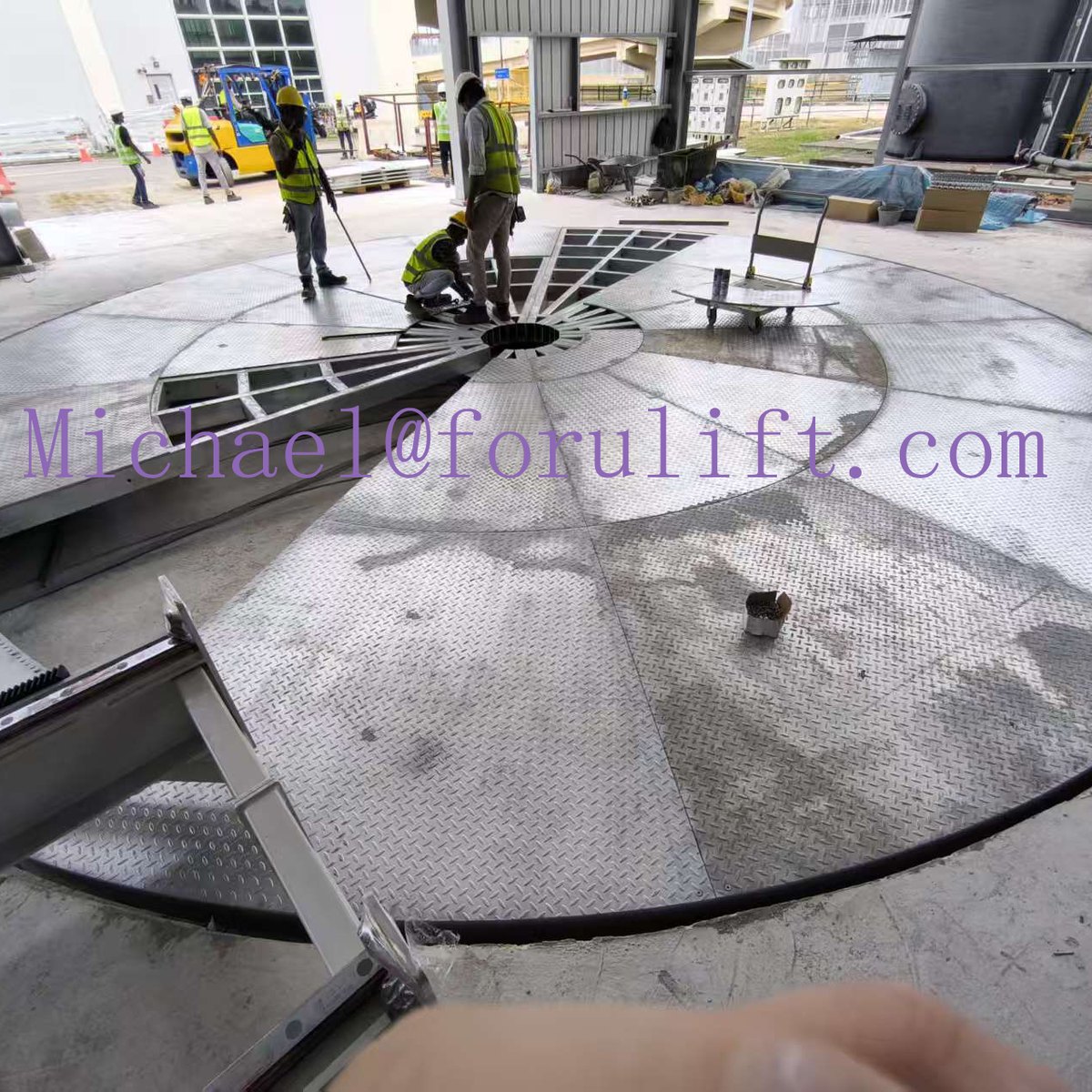
A vehicle turntable is a powered circular platform that rotates a vehicle in place. Our large-vehicle case record describes a TT3016 project with a 30 t load capacity and a 16 m diameter. It also records a usable top surface of 12 to 16 m and capacity for a 14 m vehicle length. The installation is intended to sit flush with the surrounding ground.
Those figures should remain separate in the specification. A 16 m nominal diameter, a usable deck range of 12 to 16 m and a 14 m vehicle envelope answer different questions. The buyer needs a drawing that shows the actual deck edges, the vehicle position, the clearance around the loaded vehicle and the relationship between the rotating platform and the fixed pit frame.
Which dimensions define the real vehicle envelope?
Start with the largest vehicle that must fit, including any bodywork, mirrors, ladders, tanks or tow fittings that project beyond the basic length. The Bangladesh project was scaled for a 14 m vehicle, but a recorded vehicle length alone does not establish safe clearance for every configuration. The operating layout should show how the vehicle enters, stops and leaves without relying on the turning circle that the turntable is meant to eliminate.
Then compare the vehicle footprint with the top surface. The case data gives a 12 to 16 m usable deck for a 16 m diameter unit, so the edge geometry matters. Confirm the vehicle’s wheels remain on the intended surface and that the approach at the joint between fixed ground and rotating deck is suitable for the site. These are layout questions to settle before foundations are built, not details to leave to the installation team.
How is a large turntable supported and driven?
The TT3016 case uses a large slewing bearing, a 2.0 kW motor and a rotation speed of 1 to 2 rpm. The slewing bearing carries the rotating platform and gives the project a single central support arrangement rather than the pin-gear system used on the smaller 5.5 m TT2555 case. The application is different: one handles a 2.5 t car, while the 16 m case is specified for 30 t and a vehicle up to 14 m long.
Do not infer the steel section, bearing size, gearbox ratio or foundation loads from those headline figures. They belong on the actual engineering drawing for the selected model. A tender should request that drawing, the mounting detail and the structural fixings so the building or yard work and the turntable are designed together.
How does it compare with a smaller car turntable?
The 5.5 m project and the 16 m project show why capacity, occupied area and support method have to be read as a package.
| Requirement | 5.5 m TT2555 project | 16 m TT3016 project |
|---|---|---|
| Capacity | 2.5 t | 30 t |
| Turntable diameter | 5.5 m | 16 m |
| Vehicle or deck scope | A car-sized showroom or driveway installation | 12 – 16 m usable surface for a vehicle up to 14 m |
| Finished height | 420 mm | Flush with surrounding ground |
| Drive and support | Pin gear with an RV63 reducer and Harbin bearings | Large slewing bearing with a 2.0 kW motor |
| Rotation | 1 – 2 rpm | 1 – 2 rpm |
| Principal site interface | Ground preparation for the 420 mm unit | 300 x 100 mm pit frame and flush surround |
What site work does a flush installation require?
The large-vehicle project is designed to finish flush with the ground. Its case record includes a pit frame of 300 x 100 mm. That frame is part of the interface between the rotating equipment and the fixed surrounding structure; the site design also has to account for the foundation, the approach surface, water management and safe access around the vehicle.
The finished level should be checked together with the edge detail. A turntable that is flush at the centre but has a step, loose cover or poor joint at the perimeter creates a problem for a long vehicle crossing onto the deck. Show the fixed frame, rotating edge and surrounding paving on the same layout, and have the structural design checked for the actual local conditions.
What should a large-vehicle procurement package specify?
A clear package begins with the vehicle schedule: maximum length, width, height, axle configuration and operating load. For this 16 m case, the key headline requirements are 30 t capacity, a 14 m vehicle and a usable deck range of 12 to 16 m. Convert those into agreed vehicle clearances and stop positions on the layout drawing rather than leaving them as text alone.
The equipment requirements should identify the 16 m diameter, flush installation, 300 x 100 mm pit frame, 2.0 kW motor, 1 to 2 rpm rotation and large slewing bearing support as applicable to this configuration. They should be accompanied by the final dimensioned drawing, mounting arrangement and operating instructions. A buyer should also define the controls and stop positions required for the site instead of assuming that every installation follows the same operating pattern.
What was required for the Bangladesh project?
For the Bangladesh case, the recorded requirement was a 30 t turntable with a 16 m diameter and a 12 to 16 m top surface for a vehicle up to 14 m long. The design placed the platform flush with the ground, used a 300 x 100 mm pit frame, a 2.0 kW motor at 1 to 2 rpm and a large slewing bearing. It is a useful example of why the enquiry has to state the vehicle, not only the tonnage.
The same capacity on a shorter turntable would support a different vehicle envelope, while the same diameter with a lighter vehicle would call for a different structural and drive specification. That is why the maximum vehicle dimensions and the required usable surface belong beside the load rating in the project brief.
Frequently asked questions
Is a 30 t rating enough for every 14 m vehicle?
No. The 30 t rating must be checked against the actual vehicle weight and load distribution, not only its length. The specification should record the maximum vehicle mass and how it sits on the usable deck. The case data describes the intended application, while the final design still has to be approved for the vehicle schedule.
Why does the usable deck differ from the turntable diameter?
The circular equipment includes an edge and the interface with the fixed pit frame, so the nominal diameter and the available top surface should be shown separately. The TT3016 case lists a 16 m diameter with a 12 to 16 m usable surface. Use the dimensioned drawing to confirm the position of the 14 m vehicle.
Can a 16 m turntable be installed above ground?
The large-vehicle case is designed to finish flush with the surrounding ground and uses a 300 x 100 mm pit frame. A raised alternative would change the access and supporting structure, so it should not be assumed from the flush installation. Ask for a drawing for the specific site arrangement.
Next step
Send the vehicle dimensions, maximum mass, approach direction and site photographs, and we can review the required deck and support arrangement. Start from the car turntable product page, read pin gear or slewing bearing: how the drive systems differ, and see what a 5.5 m driveway installation involves.